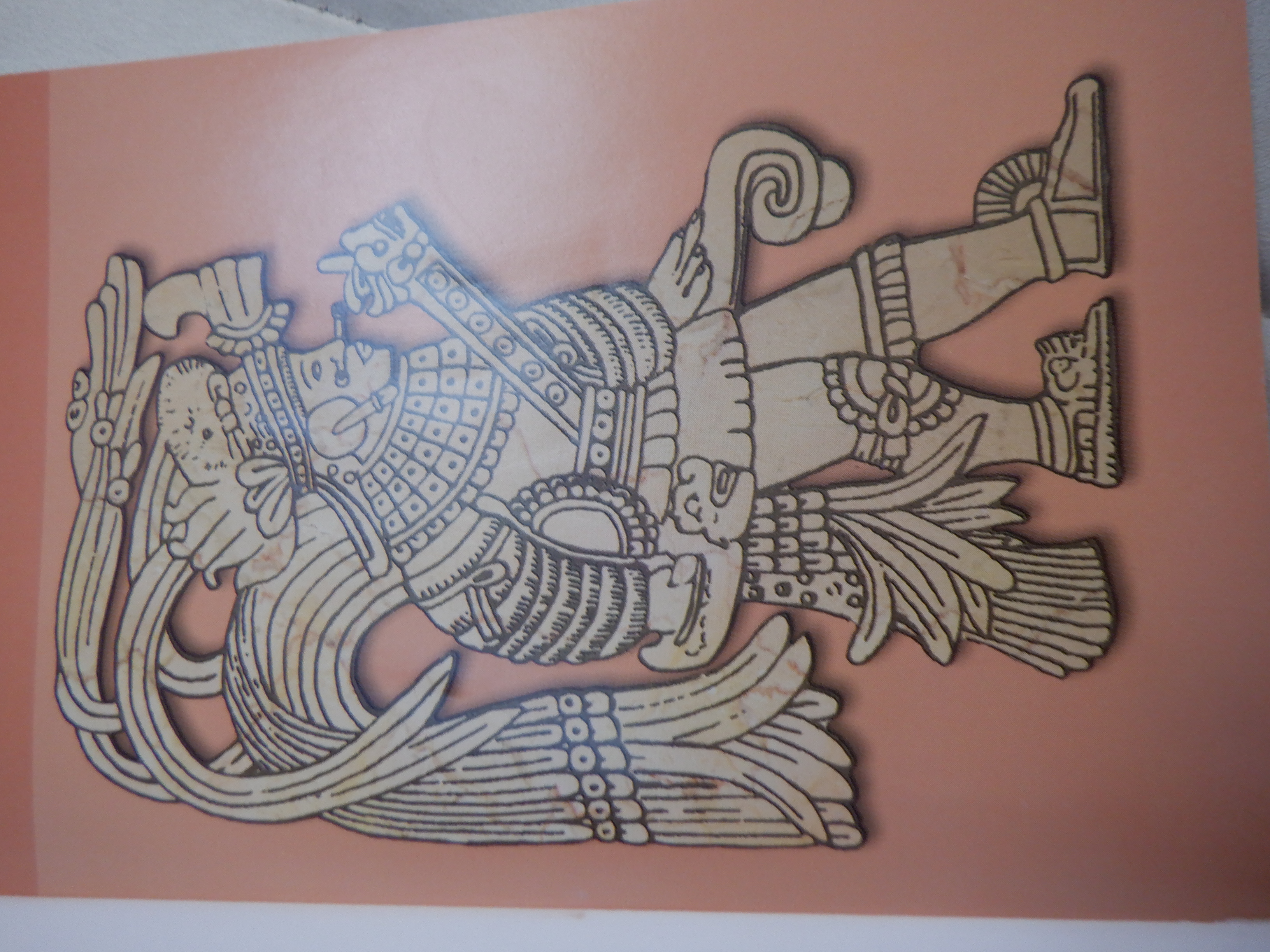
On our way back to Capri, we stopped in Yucatan in southern Mexico. Here, deep in the jungles, one finds a great concentration of the ancient Mayan city ruins. I will describe our visits to three of the cities, but first a bit about the Mayan civilization itself.
At its height, the Mayan empire stretched from the middle of Mexico in the north, south over Guatemala, Belize, San Salvador and parts of Honduras. The Yucatan peninsula in Mexico was one of the densest populated. The first Mayans arrived approximately 11,000 years before Christ. They were hunter/gatherers living in small tribes in the jungles. Sometime around 2,500 B.C. more Mayans arrived and these were agricultural in nature. Agriculture meant the small tribes could now grow and establish towns, eventually cities.
Approximately 2,000 B.C. the villages grew, pottery was invented and over the next 1,500 years, the villages grew to become larger entities – cities.

The citification began in the south and slowly worked its way northward arriving in Yucatan about 500 years B.C. The large cities, such as Chichén Itzá, Tulum and Coba were built during this time, as well as many others. They existed, for the most part, until the Spanish Conquistadors arrived, invaded Mexico and Central America, destroying the cities and the culture.
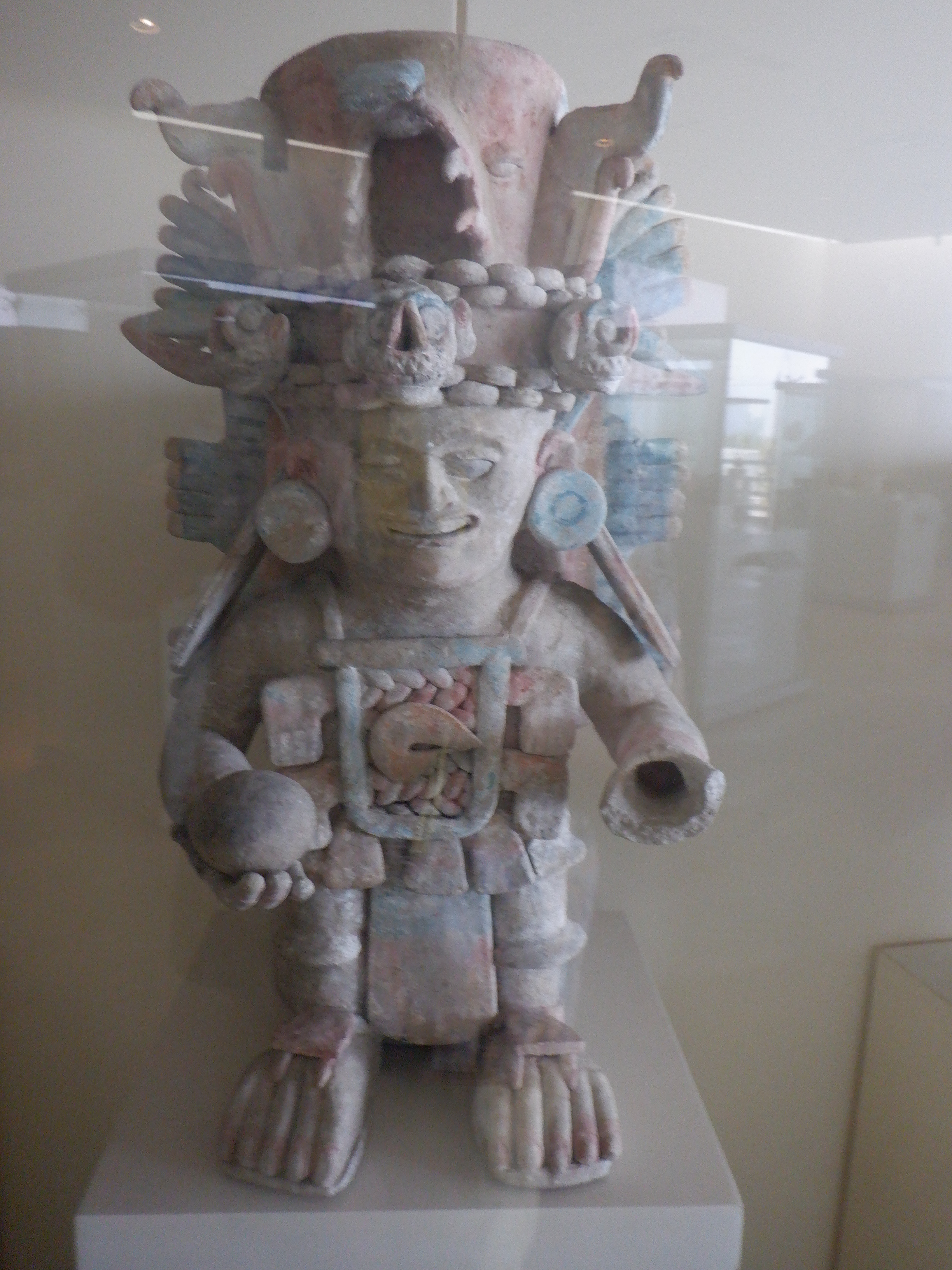
Mayan culture was built up around a nobility (direct descendants of the Gods) and then everyone else (slaves, peasant, workmen, tradesmen etc). The Nobility made all decisions and the world existed to serve them. The Mayans had a multitude of Gods and while they worshipped basically the same set of gods – their names and facsimiles changed throughout the empire. Unfortunately, we know little about the Mayans. There are few written texts. Only three books are known to have survived, all others having been lost either to time and natural elements or destroyed by the Conquistadors or Jesuit missionaries. Most of what we know has been learned by studying what is left of frescos and the hieroglyphics etched into the walls of their buildings and temples. There are some large frescos in the major temples, but unfortunately, these are in poor condition due to weather and looters.
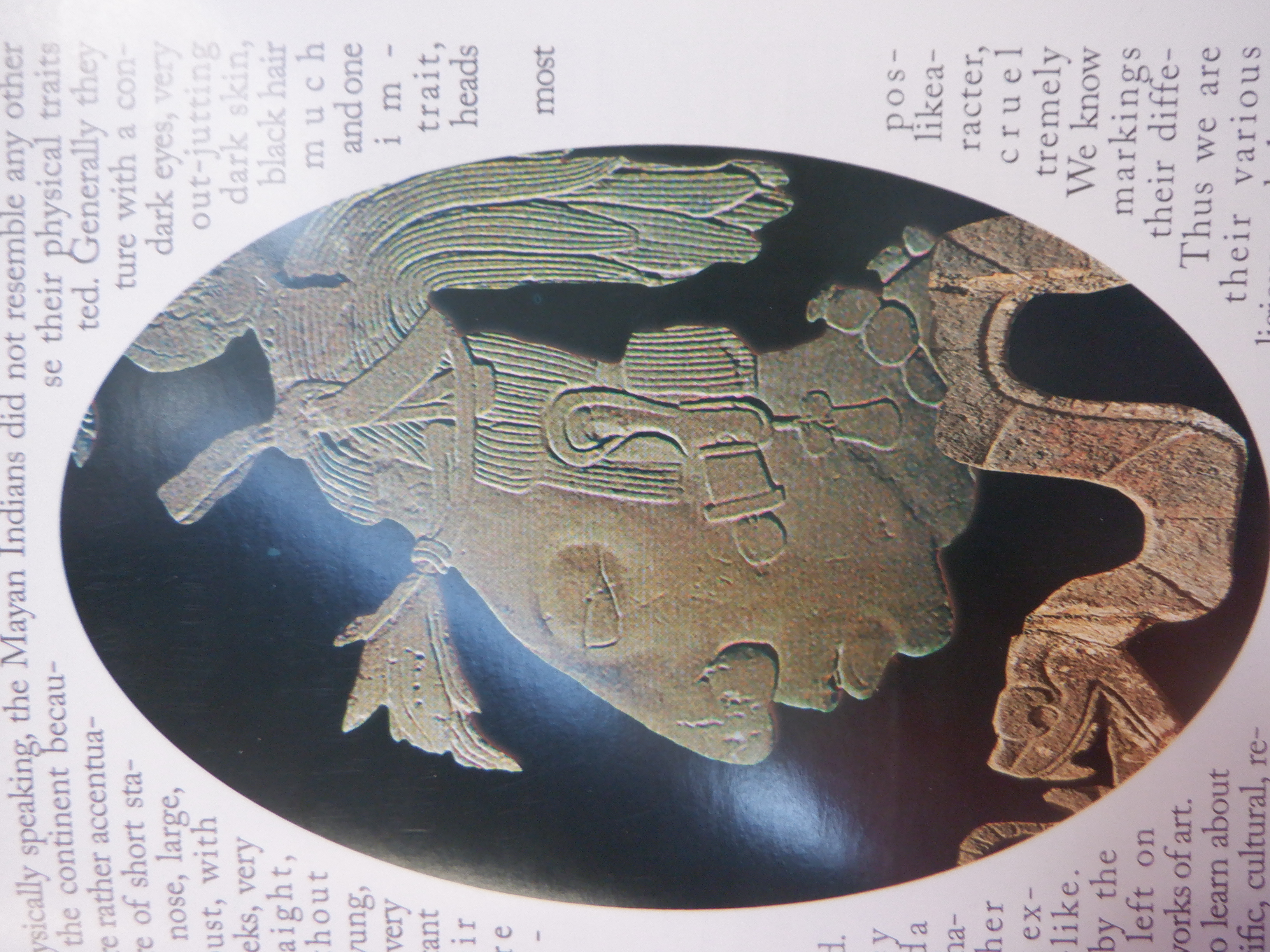
The Mayans were short of stature, the men just over 5 feet tall and women generally 4-5 inches shorter. They had (and their descendants today) very round heads, which they found unattractive. Their idea of the perfect head shape was a pointed head. To achieve this they tied boards on the heads of infants to force the newborn head to grow into the desired shape. They also thought that crossed eyes were attractive and they tied a small stone on the nose of the newborn to make them cross-eyed.
The cities were frequently at war with each other. Prisoners were either executed or made slaves. Captured warriors who had exhibited great skill and courage were tied with a rope from their neck to the center of a small platform. They were then given a wooden knife to defend themselves against 8-10 warriors who tried to stab or cut them from around the platform. The problem was that the attackers were armed with obsidian knives, a stone that can be sharpened to an edge sharper than the finest steel. That meant there could only be one outcome. The warrior who made the killing cut was granted the right to skin the body and wear the skin as a robe for three days. This, it was thought, imparted the skill and courage of the dead warrior to the victor.
The Mayans were, by our standards, quite bloodthirsty. They played ball in their ball courts, amongst which, the one at Chichén Itzá is the largest discovered so far. The teams played against each other with a large rubber ball. The goal was a stone ring set high on the opposing team’s wall (see Chichén Itzá video). Putting the ball through the ring meant a goal was scored. Archeologists are uncertain how many goals were necessary to win the game, but they are sure that the captain of the losing team was ceremonially beheaded by the winning team’s captain. In this league, there were serious consequences for losing. The Mayans, however, did not see death as a problem. They were completely convinced that death was simply a doorway to life with the Gods.
The Mayans had a highly evolved mathematical system. The Mayans were the first to evolve the concept of -0-. Having a “Zero” meant that you could now have decimals and thereby have a numbering system that could count to infinity. They were astronomically astute and knew both the star systems and lunar phases. Their calendar consisted of 13 months of 20 days each, total 260 days. But they used two calendars, the “short calendar – 260 days) and the “long” calendar (18 months of 20 days = 360 days plus 5 “bad days”). By using both calendars simultaneously, the calendars would coincide every 52 years (a “century”). This calendar system is still in use by the Indians today, especially in Guatemala.
A number of the Mayan cities were deserted before the Spanish came. Why is still a bit of a mystery? There are many theories, but the most accepted theory is that the cities simply became too big. Many of them counted over 50-60,000 inhabitants. A population of this size requires enormous areas of agriculture, not to mention the amount of water that was needed. Despite Yucatan being a tropical rainforest, there are very few rivers or lakes. Water is a precious commodity and the cities would have endured water scarcity on a regular basis. Other issues would have been disposal of sewage. Generally, it is thought that the cities simply ran out of water and were deserted.
The arrival of the Spanish Conquistadors sealed the fate of the Mayan cities and culture. The Indians could not fight successfully against the Spanish cannon and guns with only knives and spears. The Spanish were not interested in anything but gold, silver and jewels. Those Mayans they didn’t slaughter; were put to work as slaves in either the mines or agriculture. The last Mayan city was conquered by the Spanish in 1697.
There are still many Mayan Indians in the Central American area today. We saw many as we drove around. They are still short and have very round heads, are dark in their skin color and have thick coal black hair. They still speak their Mayan language and many still live in small huts that have remained the same since the times of their ancestors 500 years ago. Best guesstimates are that there are over 600,000 Mayans scattered across Yucatan, but no one knows for sure. Even the Mayans have no true idea.
Chichén Itzá
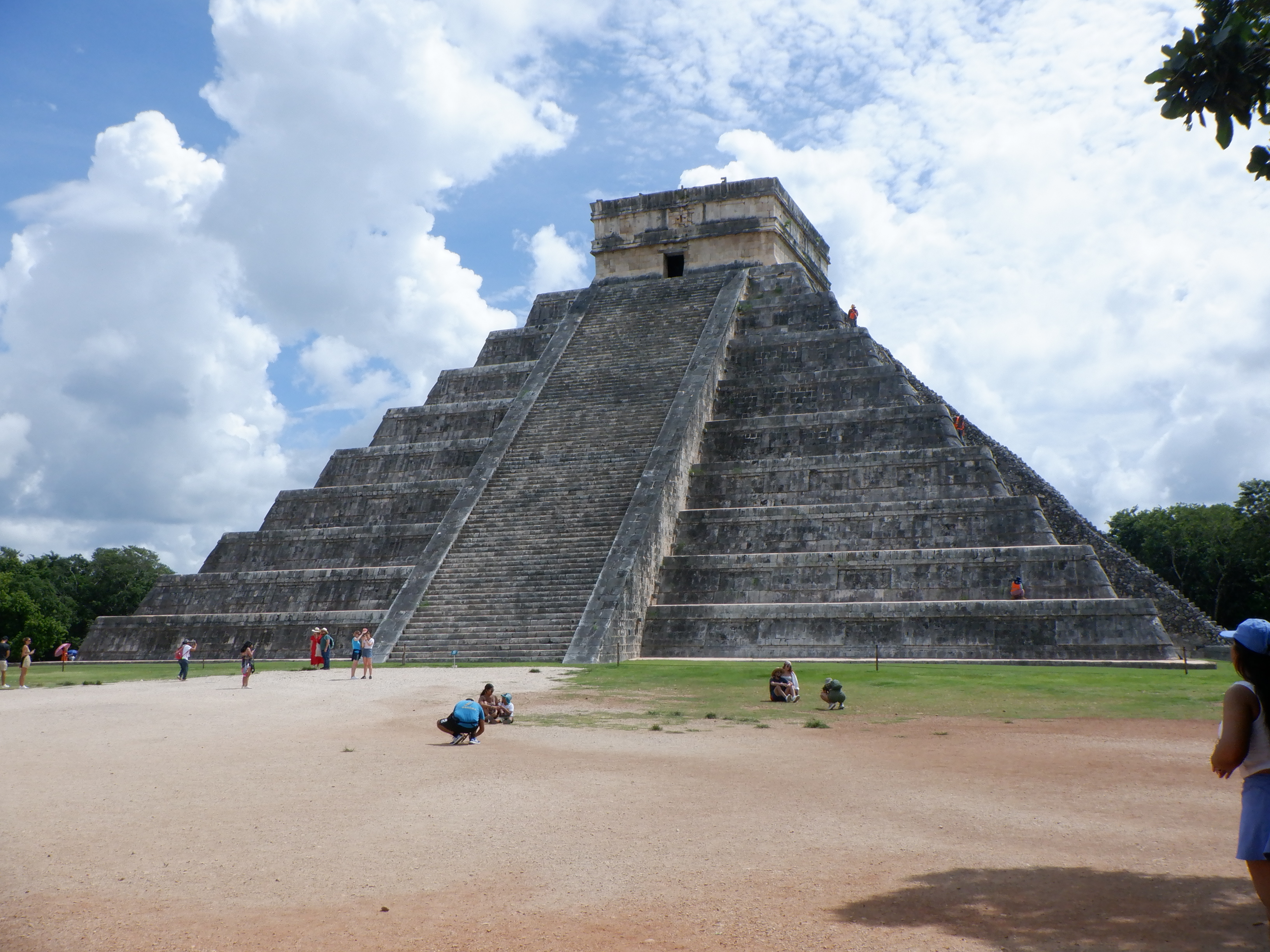
The city we visited was Chichén Itzá, which is also the city that has been excavated the most. After you park your car and pay admission, you walk on a long path through the rain forest.
At the end of the path you get a “in your face” experience – WOW!!!! Right in front of you is the great Temple or Pyramid. It is impressive. Platitudes roll off your tongue, impressive, unbelievable, WOW!, takes your breath away etc etc. None truly describes what you see. We came early (before the tourist busses), so there are few others here. The Temple is 24 meters high, has 9 layers and is topped by a small building. There are 91 steps to the top on each of the 4 staircases, which probably have their basis in the calendar (4 x 91 = 364). On each façade, there are 26 cut depressions on each side of the staircase, so 52 cuts on each of the 4 sides. Again, this is related to their calendar since a Mayan “century” was 52 years. Unfortunately, it is not allowed to climb the stairway and see the inside of the small building. The guidebook says there are a number of beautiful frescos showing warriors in full battle gear. Too many tourists have climbed and ruined much – so no one is allowed now.
To the left of the Great Temple lies the ball court. As mentioned, this is the largest ball court yet discovered. Yet discovered, because archeologists are still finding previously unknown Mayan cities. There may well be another, even bigger ball court somewhere out in the jungle. This court is almost 100 meters long and 30 meters wide. As noted above, no one is completely sure just how the game was played. Many archeologists believe the game required that the ball be passed through the stone ring set high on the wall. Others say that the object of the game was to keep the ball in play and not let it touch the ground. Why have the rings then?
No matter what the object, as I noted above, the penalty for losing was extreme. Frescos and carvings on the walls here show the losing Captain being decapitated by the winning Captain. I suppose this penalty is highly motivating.
Just alongside the ball court lies Tzompantli, a 60 meter long, 12-meter wide platform where images of human heads are carved on the side. Supposedly, this platform had hundreds of spears erected on the top. Each spear had a head, either an enemy or a losing ballplayer set on the tip.

As we walked around the excavated part of Chichén Itzá, we begin to gather an impression of just how big this city was. Archeologists estimate that at its height, Chichén Itzá had a population nearing 60,000, making it a major city. Considering that population size, it becomes easier to understand how the city declined and met its fate. Certainly, there was the problem of water. 60,000 people consume huge amounts of water each day. Getting rid of sewage was also a major undertaking. And garbage. All this needed to be carried out of the city and deposited somewhere. As the city grew, the places to deposit sewage and garbage would inevitably be further and further away. The Mayans knew perfectly well what a wheel was. But they didn’t use it, for some reason. Water was brought in in ceramic pots and large ceramic vessels. All the above tasks were performed by slaves, hauling it on wooden pallets. Certainly not very effective. Horses were unknown – the first horses in North America came with the Spanish. There were probably also never enough slaves to do all this work consistently and effectively.
On the third side of the Great Plaza, stands the Temple of the Warriors. The Temple is four stories high and decorated with bas-reliefs of jaguars, eagles and fantasy animals. All of whom are depicted busy devouring human hearts. The small building at the top of the Temple has Serpent heads atop each of the four corners and inside there are frescos depicting warriors and Gods.
While the building in itself is quite impressive, the surrounding area is even more impressive. The building is surrounded by 2,211 stone columns, each column depicting a warrior. All the depictions are different, meaning that living warriors must have posed for the carvings. The physiology and clothing on each depiction also differs. The columns closest to the Temple depict priests and those directly in front of the Temple show prisoners with hands tied behind their backs.

There are many buildings in Chichén Itzá. The city is far from completely excavated. Teams of archeologists can work here for the next couple of centuries before excavating it all. When the city was largest, it stretched over an area covering 25 square kilometers, with more agricultural land outside this “city area”. Archeologists work here every day, but as usual – there is never enough money, they are few and simply can’t keep up with nature’s destruction. As we walk around, we see many large dirt and stone hillocks, evidence that here is another building yet to be excavated.
Coba

Our next ruins was the city of Coba. Very little excavation has been done in Coba and no restoration such as we saw in Chichén Itzá. Coba was a crossroads in the Mayan Empire. Roads stretch in all directions from Coba.
Most Mayan roads were paved with flat rock. Since the Mayans didn’t use wheels, the roads were as flat as possible since everything was hauled on pallets.
Coba lies beside two large lakes, very unusual in Yucatan where lakes are a rarity. Coba would have had no water issues. No one knows how large Coba was, since it lies virtually as it was discovered. The pathways here go past one large hillock of dirt and building rocks after the other. The hillocks range from small to extremely large and it is easy to see that it will be a herculean task to excavate this city.

Even excavating a small portion will take decades. Two ball courts have been discovered and excavated, though both are considerably smaller than the main ball court at Chichén Itzá.

Here we also found a reconstruction of the houses “normal” Mayans lived in. They are built of wooden poles, covered in mud (adobe type) with palm leaf roofs and have only a single room. The houses were built mainly to provide shelter from the rain and wild animals (jaguars etc.). Yucatan is a tropical rainforest so cold is never an issue.

Coba lies far out in the jungle. Very far. I can assure you that you do not want to have engine failure on the trip out here. Almost no one else is driving here. Although there are people living out here in the jungle and this road trip was one of the most fascinating parts of our visit to Yucatan. The descendants of the Mayans live in these jungles and it is clear that they are still Mayans. The (few) we saw were all short in stature, very dark-skinned with coal black hair. The houses they lived in were the same as the ones “reconstructed” at Coba.

Don’t ask me what they did to make a living out here. We saw no fields, only tiny kitchen gardens. No electricity, of course. Forget telephones, mobile or fixed net. We drove through a tiny village with scattered houses. There was a school and a small store.


The jungle is close here. It is impenetrable, unless you are using a machete or an ax. The growth is so impenetrable that it will be more than hard work to carve a path longer than a meter or so per hour. The temperature is high, close to 100 degree F and humidity is 100%. If you stand completely still in the shade, your clothes will be soaked with sweat within minutes. You cannot drink enough water.

Coba was conquered and destroyed by the Spanish in 1521.
Tulum

Our last Mayan ruin is Tulum. This city is the most visited by tourists, also the most excavated. It lies only a couple of hours by good road from Cancun and the tourist busses line up in convoys to disgorge thousands of tourists daily. If you want to visit this Mayan ruin, you have to get up early in the morning – otherwise all you will see is other tourists.
The Great Temple here lies on the edge of the cliff, overlooking the sea. This city was undoubtedly founded here because there is a natural “harbor” just below the Temple. Here the coral reef has formed a semicircle out from the coast, with a narrow inlet, allowing boats to anchor in shelter from storms. The Mayans used this harbor and traded with cities further south and north. Tulum was one of the largest Mayan trade centers and both large as well as small freight canoes came here carrying goods, passengers and slaves. We are certain that canoes from here traded as far south as the Honduras. Tulum is the only known Mayan city to have a protective wall built around it. There are watchtowers several places along the walls, so Tulum was very conscious of their need for defense, probably due to the large amounts of goods passing through here.
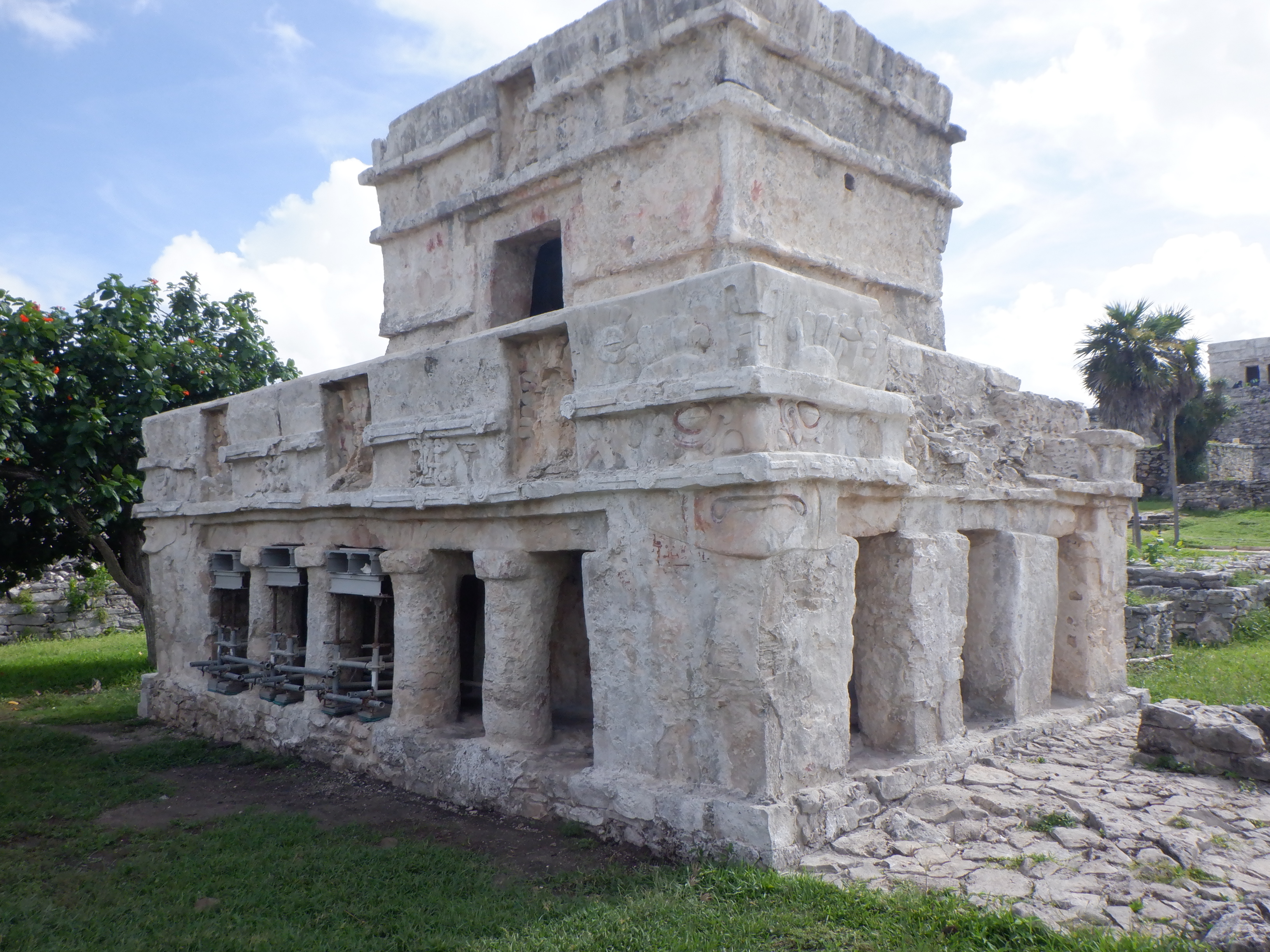
Despite Tulum being the most excavated Mayan city, we saw a team of archeologists hard at work under a sun tent. Working on their hands and knees, using brushes and tiny shovels, they were uncovering a small segment of flooring.

We only visited these three cities – there are many more. Most of them lie even further out in the jungle than Coba – many of them have not yet had a visit from archeologists. They are only places marked on a map. The past many years, archeologists have made infrared photos of the jungle from airplanes and discovered many new cities that were previously unknown. Every year, new ones are found. No roads go there. If you want to go there then it is on foot or perhaps riding a donkey. The authorities are not happy with amateur archeologists visiting these sites and permission to go is required.
We have long had a desire to visit these wonderful cities and now we managed it. The Mayan civilization was quite advanced and shamefully the Spanish destroyed it in their lust for gold, silver and jewels. Just as in Egypt, it is not known just how these Temples were built. Certainly, it required thousands of slaves and many years. The many bas-reliefs are carved in stone using other stone tools – a major undertaking.
This is worth making a separate trip to see – if you also need some holiday festivities – Cancun is a beach paradise.


 s/v capri
Merry Christmas.
Hope to see you in the new year.
Love
Lene