Before we leave Mexico we need to get a Zarpe (clearing out proof), just as we have from every country we have left over the past 8 years. This time we also need to have our TIP (Temporary Import Permit) for the boat cancelled. If we don’t and the next owner of Capri decides to sail to Mexico, they will have mega problems. The day before we set sail for Nicaragua, Carsten spends a half-day and USD200 for a taxi out to the border between Mexico and Guatemala to meet with a customs officer.
The next morning, the harbormaster, immigration, Mexican Navy and a narcotics dog arrive on board Capri. This is the same team of authorities that climbed on board when checked into Chiapas. The dog checks for not only narcotics but also illegal aliens. When we checked in the dog wandered around on deck, stuck his nose down through our hatches and the Navy was satisfied. This time, the dog has to go down into the salon and into our other cabins to ensure we have nothing to hide.
Why have the dog check us when we arrived? After all, we were coming from Mexico to Mexico, domestic. According to the authorities can’t be completely sure that we haven’t sailed just a bit further south and picked up some illegals and come back.
Ok, I guess we can buy that, but now we’ve been here in the harbor the whole time, so why the dog for when we leave? You’d think the authorities could care less when we leave, but they do care. As soon as the dog is finished, the harbor personnel begin casting our lines off. The rule here is you leave immediately and immediately means just that. As we leave the harbor and sail out through the river entrance, we pass the Navy gunboat anchored there. Just as when we came in, they took pictures of Capri.
The morning was full of surprises. The weather forecast said light to fresh winds with swells of about 1 meter. When Vinni and Carsten go sailing, of course, weather forecasts mean nothing, so we get strong winds right on the nose and 2-3 meter high swells – oh happy days. Fortunately, the period of the swells was about 15 seconds so they weren’t a big deal, but still. Capri crawled up and down these swells with the engine running at 1800 rpm. Finally, we cleared land, could turn southward, set sails, turn off the engine and begin to enjoy a wonderful sail that lasted until late afternoon when the sea breeze died.
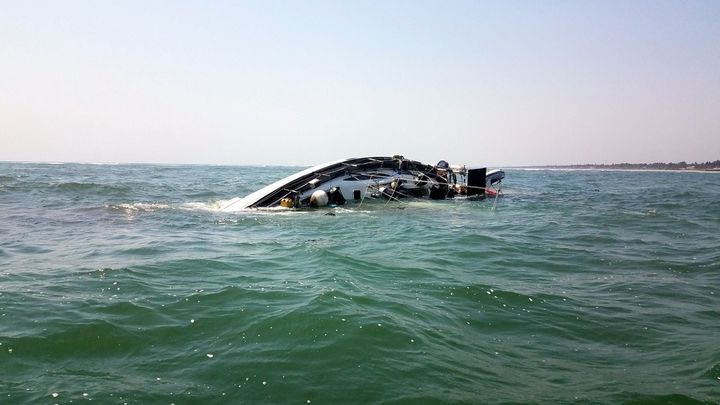
The next three days, we alternated between sails and engine. Sails during the afternoon sea breeze, engine for the rest (yes we burned quite a bit of diesel). As we noted in our previous blog, we decided to take a pass on Guatemala. Clearing in to that country costs an arm and a leg and while we would have liked to stop, there really wasn’t anything there we desperately wanted to see. We also skipped El Salvador. The loss of a boat on the sandbar at Bahia del Sol was enough to convince us that we didn’t want to stop there. We put Capri and ourselves at risk a lot, but never knowingly and never, where we can avoid it. All this, means we sailed directly from Mexico to Nicaragua. As we pass Bahia del Sol during my night watch, I send an emphatic thought to the skipper who lost his boat at the entrance. I can only hope it never happens to us. The thought of losing Capri is simply beyond my imagination.
We are now in that area of Central America infamous for its Papagayo winds. These tunnel winds are created in areas where there are low passes through the mountains. The trade winds from the Caribbean blow through these passes and are multiplied in force, easily reaching storm force here on the Pacific side of the land. To safely navigate this area you need not only to keep a close watch on the Pacific weather but also the Caribbean weather. If there is a high-pressure system in the Caribbean, the Papagayo winds will blow even harder, sometimes lasting up to eight days.
These powerful winds come up against the large Pacific swells coming from the west and generate huge choppy seas. Sailors that have tried to pass through these even as far out to sea as 50nm have run into horrible winds and seas. The strategy here is to stay less than 10nm from the coast so you can make a run further in if you are unexpectedly caught. This is our strategy, we follow the coastline about 8-10nm out.
Funnily enough, a couple of months ago when we were thinking about this route, we decided to sail at least 100nm from Nicaragua’s coast because we were afraid of pirates. We do have to say that we have only heard of piracy on the Caribbean coast of Nicaragua, not the Pacific side.
Did I say something about putting Capri and ourselves at risk?
Two days after setting sail, we met the Papagayo winds, just as they were getting started. We know that it will take a least one full day before they reach maximum strength, so we push on as fast as we can to reach the only marina in Pacific Nicaragua. We expect that we will be “blown in” due to bad weather (winds) for 7-9 days. The winds are moderate but increasing as we pass Bahia de Fonesca. This is a giant bay is where El Salvador, Honduras and Nicaraguan borders meet. It also happens to be the place where northern Pacific hurricanes are born. Fortunately for us, this is not hurricane season.
We’re sailing as close-hauled as we can (the wind is right on our nose), all our sails up and we still need the engine going to help us fight our way up against the wind and 2 ½ meter high chop. This is nasty sailing. We can’t sail into the bay and hug the coast. The water in there is much too shallow for Capri so we simply have to stay out here and take our spanking. The good news is the winds have not reached full strength yet – the really nasty winds won’t come for another 24 hours. We fight the wind and swells all day, being knocked about and cursing the weather (as any good sailor knows how to do). As we get past the bay and into the shelter of the mountains, the wind dies down and the swells smooth and we can let up.
Marina Puesta del Sol is the only marina on the Pacific side of Nicaragua. All the pilot books warn against anchoring out in smaller coves due to crime, unwanted boardings etc. The harbormaster warned us to only attempt to enter at high slack tide. The marina lies 3nm up a larger river and the channel is tricky as it snakes its way upriver between sandbars and reefs. With our 7 feet, we can’t enter at low water. In between, the current runs as high as 6 knots – so this is really crap. As we near the marina, we slow down and then slow down some more so we will arrive at high tide at 7 a.m.
One of our sailing friends came in here a week ago and told us that he experienced 2.5 knots of following current a half hour before high water slack. He was also surprised that there were no buoys marking the channel. The pilot book says there are, although the chartplotter doesn’t. He got the GPS coordinates of the missing buoys from the harbormaster and has been kind enough to send them to us so we can mark them on our chart plotter.

It is 7 a.m. and after 3 days at sea, we turn into the river and follow our marked channel upriver. Our log still isn’t working, so we don’t know how much foul current we have, but at one point Capri is almost sailing sideways so we think we have about 3-4 knots running foul. At one point, Carsten has Capri pointed directly at shore and we are quickly approaching it. I nervously ask if we are still in the channel and Carsten reassures me that he is in the middle of the channel and we are actually, appearances to the contrary, heading upriver. I close my eyes and hope skipper knows what he is doing.
Sometime later, we enter the little marina and can tie up at the dock. All without running aground. As we look around, we can see seven cruising boats that, as we later learn, all have skipped El Salvador and Guatemala.
The little marina is part of a complex with a hotel, restaurant and not least – a swimming pool! The hotel is closed at the moment (no guests), the restaurant is only open in the weekends (only guests are the sailors), but the pool is open every day. The only problem is that the sun is so strong that the pool water is as warm as a very warm bathtub, so jumping in doesn’t mean you are cooled off. The air is humid, very humid, extremely humid. Did I mention the air was humid? Something around 95% humidity.
Did I mention the very high humidity?
All the gringos (read: white people from up north) suffer in the high humidity and we meet at the pool every afternoon. No one in their right mind is sunbathing; we fight for the chairs in the shade. Never have Carsten and I enjoyed cold showers this much.
The first evening here we sat in the restaurant on their marvelous deck that is standing out over the water on huge poles. It is exotic as it should be, with a roof made of banana and palm leaves, wooden floors etc. etc. Suddenly the entire deck and restaurant is shaking so much that I almost fell out of my chair. “Wow” I said, “that was some wake that panga that just passed threw up”. Carsten looked over at me and said – “That was no wake, that was an earthquake” Ok, so now I also experienced that. My first earthquake. Turns out it 5.1 on the Richter scale.
I was not aware that Nicaragua is one of the places in the world with the most earthquakes. The abundance of earthquakes is probably one of the reasons no one has built a second Panama Canal here. It has been discussed many times; lastly, a Chinese businessman says he is going to build one.
At any rate, we are weather bound here for the coming week due to the Papagayo winds. The crews of two of the boats have rented a car (including a driver) for 6 days to tour the country. The guidebooks recommend that if you rent a car, it should be with a local driver. Two of the other boats rent cars without driver and go off by themselves. Carsten and I talk about renting one and driving around. The heat and humidity here is ungodly. We’ve been places where it was hot and humid, but this is unbearable.
As I noted earlier, Carsten and I had no plans to explore Nicaragua, due to the crime here, and we certainly never expected to rent a car and drive around by ourselves. But here we are, sitting in a wonderfully air-conditioned car (nice and cool and NOT humid) on our way 350 kilometers to Granada, the oldest city in Nicaragua.
The first couple of hours we drive through rural and poor Nicaragua, where the populous lives in Spartan shacks, although a few are built of concrete blocks. The fields around us are sugar cane, used to make rum. We pass a number of horse drawn wagons and steer drawn wagons filled with firewood – what do they need firewood for in this heat? As we drive, we see that many here still prepare their food over an open fire.

In our Danish eyes, it all looks poverty stricken, but the shacks are used mainly to protect against the burning sun and rain. Everything else happens outside. The locals seem happy, clean and well nourished. Their clothes are the same as young people in Denmark wear. They don’t seem to be missing anything even though Nicaragua is generally regarded as the poorest country in Central America.
Nicaragua is a very socialistic country headed by the Marxist Sandinista Daniel Ortega, who has held power as President for 6 periods of 4 years each. Apparently, he has no plans to release his hold on the country or the power. The country has very little industry, the few industries are owned by the government, export is almost non-existent and there is little tourism. Schools and high schools are free, if a family can’t afford uniforms for their children the government will pay for them. Doctors and hospital care are apparently also free, but I am uncertain as to the standard, especially in the rural areas.
We’ve driven almost halfway to Granada when we discover that we have forgotten our passports. Shit!!! No way we can check into our hotels without them, so there is no alternative but to turn around and drive back to the boat to get them. This is a slight detour of about 200 kilometers and it is midnight by the time we reach our hotel in Granada.
The roads in Nicaragua are surprisingly good, although crammed with heavy truck traffic. One of the reasons for the heavy truck traffic is that when the Sandinistas overthrew the dictator Somoza, the country had no money. To help fund the government deficits, Government sold all the railroad locomotives and cars to Peru and the all the railroad tracks to China (scrap iron). As a result, there are no railroads in Nicaragua today. Everything moves by truck.
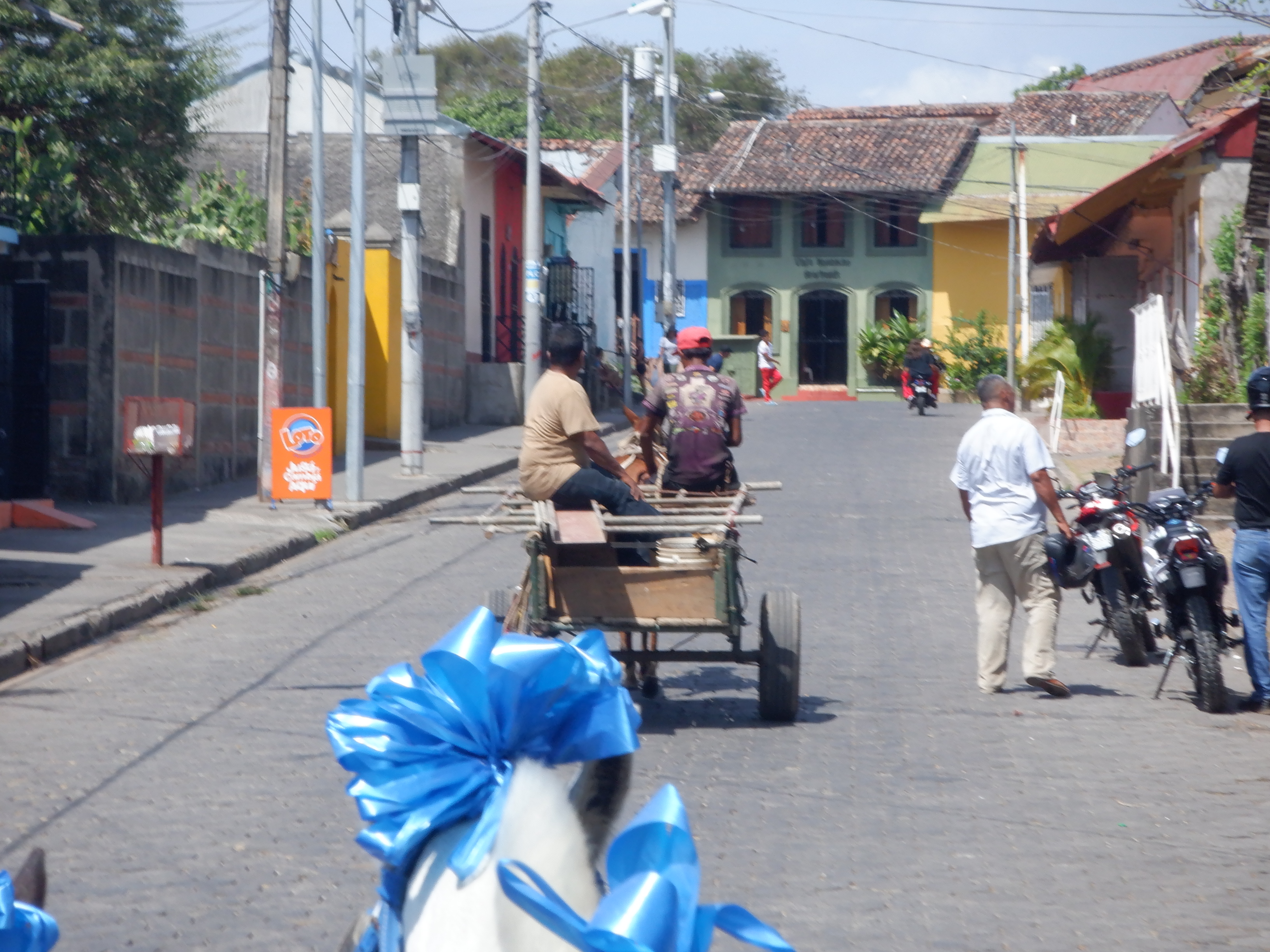
The next morning we are tourists and get driven around the historic center of Granada in a horse drawn wagon. Our driver speaks fluent English. According to him, Granada was the first city that was founded in Central America. There are a number of tourists here, most of them from Costa Rica. The city has definitely not yet been spoiled by tourism and if you are visiting Nicaragua, we can certainly recommend staying here a few nights.
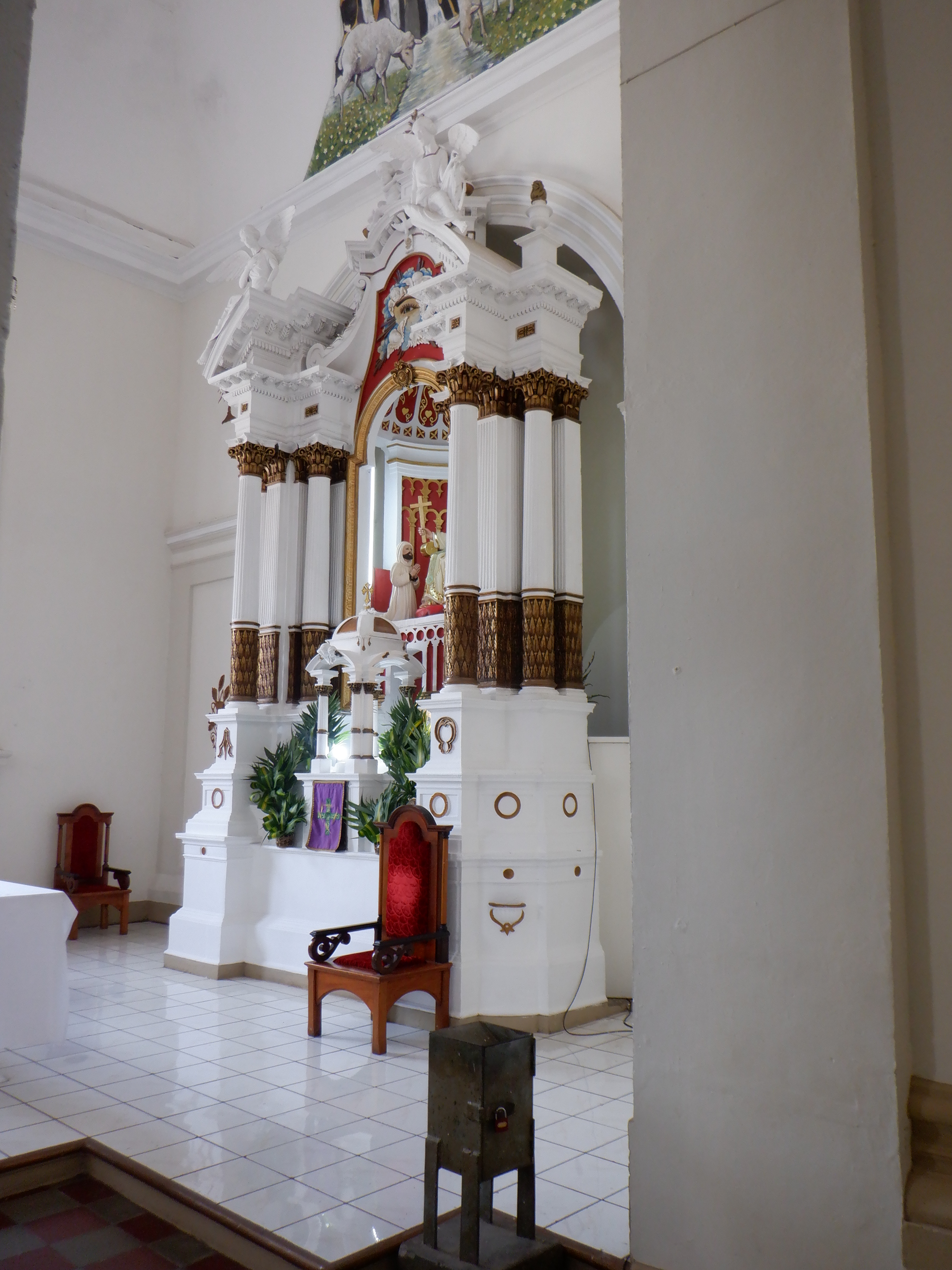
The old cathedral here is impressive. While inside I am surprised by something I have never seen. A middle-aged woman is crawling on her knees the entire length of the church to the alter while praying to the Virgin Mary, then crawling backwards the entire length of the church, before standing up and leaving. This is something we have only heard of when we visited Porto Bello in Panama



Later that afternoon, we drove to Managua, where we will take a guided tour up to the top of an active volcano at night. The special thing here is the volcano is still active and you can look down at the red molten lava. On our way there, we receive a text message saying the tour has been cancelled. Apparently, there has been a major landslide at the top and it is now too dangerous to be trekking up there. Oh well, we found our hotel and lounged by the pool. The hotel recommended that we go eat at the restaurant across the street, which we did. Here we had the best steak we have had in years. Sublimely tender and very tasty. Also cheap when looked at with our western European eyes. Managua is known for its high crime rate and tourists are warned to not walk anywhere, only take taxis.
A long day’s drive and we are back at our marina and Capri. A weather window has opened up and we can continue on to Costa Rica. The harbormaster here, Juanita, is helpfulness itself. She arranges for the all the authorities to be driven over to the marina from Corinth (neighboring city). We only need to pay the taxi fare, which we spilt with three other boats. We checked out the day before we expect to leave and then they tell us that we have to leave within a couple of hours (the norm in most countries is 24 hours).
The authorities are coming the next morning at 10:00 to check in another boat and we have to be gone before they get here. After a lot of explanation about how it literally is impossible for Capri to sail downriver at ebb tide due to our draft, the harbormaster gets on the phone and talks with the Port Captain. She says she doesn’t have the authority to allow us to stay. Juanita calls the main office in Managua and talks with the head of the department. After several minutes of discussion, he gives us permission to stay until high water. But not one minute longer.
At 1 o’clock pm, we are ready to sail. I turn on our instruments and stand staring vacantly at black screens. None of our instrumentation is working. In Chahue, it was the engine – now what? Carsten turns pale, begins to open diverse cabinets, get out his multimeter, and quickly runs out of ideas. Most of the instrumentation manuals are pulled out of the cabinet but there are no ideas forthcoming. I try to calm him down and suggest we simply check back in and take what time is necessary to find the problem. I have never seen him so stressed. Our neighbor boat’s skipper is Phil. Phil is an EE (electrical engineer) and despite also wanting to sail, is willing to come over and have a look. Carsten tells him that he has checked all the fuses; circuit breakers etc and they are all fine. After a half hour of measuring, looking and pulling on wires, Phil asks if there are any fuses that Carsten could have overlooked. Suddenly Carsten’s face lights up and says, yes, there is one fuse for the autopilot that I haven’t checked. He pulls out boxes, bags and more from our aft storage locker and Bingo!!! The fuse for the autopilot was blown, change it and everything begins to work. A few minutes later, Caja (Phil and Cherie’s boat) and Capri, glide away from the marina dock and head downriver. This time there are no dramatics, we have a following current but it is not strong. A half hour later, we are out, can turn to port and head for Costa Rica


 s/v capri