St. Kitts, Nevis and Montserrat
The islands that brush the clouds lie south of St. Martin and north of Guadeloupe. They are a small chain of islands, consisting of Saba, Statia, St. Kitts, Nevis and Montserrat. These islands are the only eastern Caribbean islands we have not visited.
We have finally overcome our anger at the refrigerator repairman that “reamed us royally” on St. Martin. Had he done what Carsten asked him to; replace the cooling element, instead of replacing the entire system, we would not have had to put Capri on the hard and we would have saved something like $3-4000.
Ok, he got to sell a unit that was on his shelf and we got a new refrigerator, but the money was a bitter pill to swallow.
It is the middle of April 2025 and we weigh anchor from St. Martin and sail south to see the Islands that brush the clouds.
These five small volcanic islands rise from the sea and “reach clear up to the clouds”, thereby their name. Since they are high volcanos, they experience a lot of rainfall and the islands are covered with rainforest. Unbelievably beautiful green islands surrounded by the blue ocean.
I’ve wanted to visit Saba for a long time and am excited that it is going to happen. The island is described as picturesque and one of the most authentic islands in the Caribbean, since there has been little tourism. Until a few years ago, it was extremely difficult to land on the island. Today there is a small dock on the southwestern coast and the island now has an airstrip. Tourism has increased dramatically.
Unfortunately, the best laid plans of mice and men……………………. We end up having to sail past both Saba and Statia. The wind has turned and is coming from the north. There are no marinas on these islands, only anchorages on the lee side. The trade winds normally come out of the east, offering shelter on the western coasts. The north wind is directing the swells straight down the western side, making the anchorage untenable. We continued past and made for St. Kitts and Nevis.
St Kitts and Nevis
St. Kitts is short for St. Christopher and named after Columbus’ guardian angel. The island was settled by the British in 1623 and shortly thereafter, the French arrived. The two group waged war for 150 years. The French finally surrendered and the island became a British colony. Before the war ended, the warring factions had managed to kill all 2000 or so indigenous population. Today, St. Kitts and its neighboring island Nevis, are one independent country.
We dropped the nook in the bay just outside Basseterre, the Capital of St. Kitts. The customs office is right on the marina dock and it is a small matter to take our dinghy in. But, this is a bureaucracy, so nothing is easy. After 1.5 hours and after keying in the exact same information into four different computer programs, we were finally cleared in and Carsten was fuming. We can’t praise the customs agents for their friendliness either. They were downright rude. We certainly don’t feel welcome here.
We got the impression that they really don’t like cruising sailors here. The main source of income for these islands are cruise ships, whose passengers are more than happy to spend lots of money. Poverty-stricken blue water cruisers who watch their pennies are frowned upon. This morning, two of these huge “floating hotels” arrived, each disgorging several thousand passengers freely swinging their credit cards. Just behind the cruise ship docks is Porte Zante, a “duty-free village”, consisting only of duty-free shops. Here you can buy Rolex, diamonds, jewels, designer clothes, booze, cigars etc. The temperature is over 30 degrees as we wind our way through the crowds of Americans and Canadians on our way to the tourist office. After getting some local information and maps, we hurry back to Capri, far away from the maddening crowds.
The cruise ships leave that evening and Basseterre returns to its usual sleepy self. The next morning we walked around the town to see the tourist sights, especially The Circus, a miniature model of Piccadilly in London.

Another tourist attraction is the St. Kitts Scenic railway. An old rai track that in past days was used to transport sugar cane from the plantations around the island to the port. It has been renovated and now it runs as a luxury scenic train most of the way around the island. According to the literature, the ride is picturesque. We decided not to take the train, since it is expensive and we rented a car instead.
We want to see the entire island, there is really only one road, it encircles the island. We start up the leeward side of the island, lush with greenery and rainforest.

Along the way we visited the “famous” Caribelle Batik, far up in the rainforest highlands. Originally, this was a large sugar plantation with a beautiful main building, which unfortunately burned. Now it is a batik factory with three large workrooms and a good-sized shop. We tour the working areas while a guide explains each step in the process of making batik fabric. The finished products are impressive with many colors and fine designs. These are so good that we buy one.
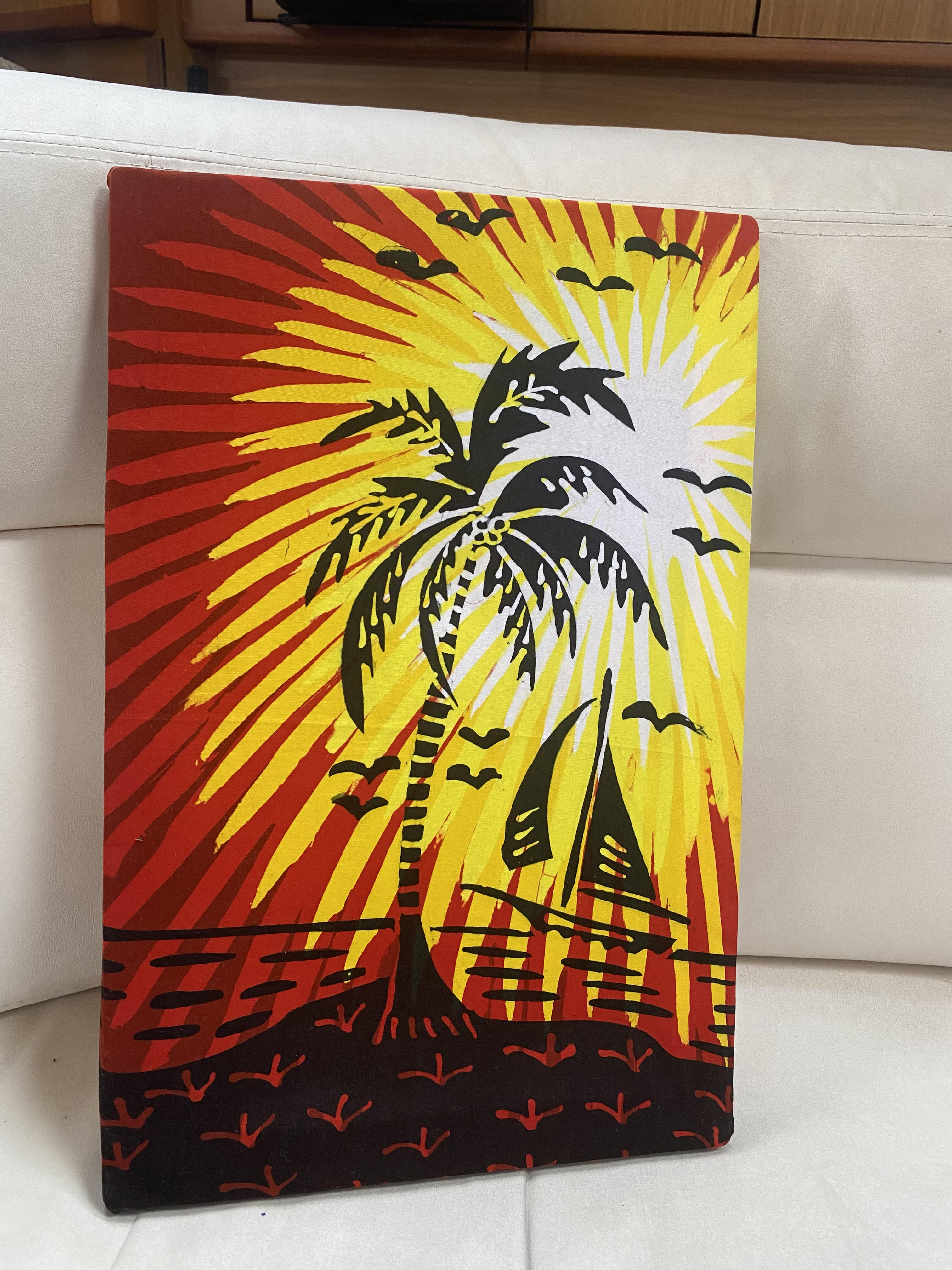
Batik from Caribelle batik
The rainforest here is hot and muggy. We need to get further up on the mountains where we can visit Fort Shirly or Brimstone Hill Fortress. Ok, we’ve visited many fortresses, but we have to say that St. Kitts has done a marvelous job of restoring the old ruins. The restoration is still underway, albeit at a slow tempo. The view from here I magnificent. On a clear day you can see six islands from here, today it is misty so we can only see Statia and Nevis.

On our drive up here, we see one of the many African apes, distinctive with their green fur on their backs. There are thousands of these apes here in the highlands, descendants of a few apes brought here centuries ago as pets.
Later we found a beach restaurant that served a good lunch and then we continued our journey around the island, this time on the windward side. We found the windward side to be much less interesting that the leeward side. The landscape is rather plain without variations. The small towns identical.
At the southern end of the island is a long appendix that stretches out into the ocean. Here we found hotels and other attractions, including a golf course. Along the way we passed several small bays where sailboats were anchored.
We got back to Basseterre just in time to return the rental car (that way we don’t have to worry about overnight parking nor about having to dinghy in in the morning to return the car. Next morning we weighed anchor and sailed south to Nevis (part of the same country, St. Kitts and Nevis) where we can clear out. The weather gods have forsaken us. Since we left the Virgin Islands a couple of weeks ago, the rainy season has begun. All the forecasts say that the further south we get the less rain, so we need to sail south.
Nevis
From Basseterre to Nevis main town, called Charlestown is only ten nm. We dropped the hook late in the afternoon. Next morning at 8:00, while we are having our breakfast, the Harbor Patrol shows up and asks if we have paid for use of the mooring ball. Carsten says, ”no, not yet. –the harbor office was closed when we arrived last night, but I will dinghy in as soon as I’ve finished breakfast”. Apparently, that simply wasn’t good enough. The Harbor Patrols demands that Carsten go in immediately and pay for the mooring ball and they mean immediately.
We aren’t the only ones they roosted out. Four other surly skippers are on their way into the harbor in their dinghies. Everyone is pissed at this treatment, which really isn’t necessary.
An hour later, after Carsten has returned and we are continuing our breakfast, the Harbor Patrol returns to check if we have been in and paid. Carsten is usually very polite when dealing with the authorities but this time he has a surly attitude and yells to them that he has been in and if they doubt this, then they can come over and he will show them the receipt and then perhaps they will leave us alone to have our breakfast. They decline to see the receipt and roar off. I don’t think we have ever experienced such a nasty attitude.
After this uncomfortable morning, we meet Isabel and Flemming, who are here on their 51-foot Catamaran. Wow! Unbelievable luxury. Sundowners are margaritas with lots of ice and a grand tour of the ship. What luxury to live like that – Carsten and I are just poor monohull sailors. We have a grand evening and since we are sailing the same way we spend a lot time together the next three weeks.
Carsten dinghy’s in and clears out. This time it doesn’t take an hour and a half, but there still is no friendliness or courtesy.
After clearing out, we took some time to wander around downtown Charlestown and admire the Victorian houses. Charlestown is much cleaner than Basseterre. There are no homeless here. The local population seems cheerful, they smile and say hello. There seems to be a higher standard of living here on Nevis that there is on St. Kitts. Charlestown is smaller than Basseterre, so that may also be part of it.
Early the next morning we upped anchor and let the wind take us the 50nm south to Montserrat.
Montserrat.
Montserrat was not colonized by the English, but rather by the Irish who founded sugar plantations and farmed. Montserrat is today an independent country.
The only place to clear in to Montserrat is at Little Bay. After having been at anchor here for three days we can recommend that other visitors anchor in Rendezvous Bay (right next door) where the anchorage is less rolly. It is an easy dinghy ride around the point to the Little Bay.
The large volcano, Soufriere on the southern end of Montserrat erupted in 1995 and thereafter there were many smaller eruptions. Larger eruptions followed in 1997, 2003 and 2006. In 2010 there was a devastating eruption where the entire south side of the mountain collapsed and buried the airport and the town around it. On the western side of the island, the Capitol city, Plymouth was buried underneath ash and volcanic lava. The city had been evacuated, but the population had nothing to return to. After this catastrophe, Ireland not only offered economic help to rebuild, but also allowed the population to immigrate to Ireland. Before the eruption, the population was just over 11,000. Today it is only 5000. A major exodus.

The population all live on the northern end of the island where they are protected from the volcano by the Center Hills, a mountain chain on the middle of the island. Seismologists say the volcano has “gone to sleep”, but who knows?
The southern half of the island surrounding the volcano has been declared an Exclusion Zone, and no visitors are allowed. A small area around Plymouth has been declared safe and tourists are allowed to visit albeit only in the company of a certified guide and only when they have filed a visit plan and checked in at the gate.
We hired a guide in company with Isabel and Flemming for the four-hour tour of the buried city. Our guide explains that today there are only two towns on Montserrat, Little Bay, the biggest, has all the authorities, police, parliament, Prime Minister etc. A little further south is a small town, Salem.
The first part of the tour is the grand tour of Little Bay. It is obvious that our guide is proud of his city and of his country. In 2010, he lived on the northern end of the island. We see all the government offices, the hospital, the prison and the bank. Nothing is passed by without comment. After the grand tour, we drive south through Salem until we reach the Security Zone on the other side of the Center Hills.
At the gate, we are met by a Security guard who checks that our guide has registered the trip and that we are exactly as many people as he has noted will on the tour. He gives our guide a VHF radio so he can call for assistance if it becomes necessary. When we leave, she will check again to make sure everyone has left the area.
Inside the gate, we are met with ash everywhere. Most of the ash has harden into a form of concrete. It si surrealistic to see a city b50-100 meters further out in the wateruried in ash. We look out over the gray area and can’t imagine that there is a entire city buried below us. I hope the pictures below can speak for themselves.

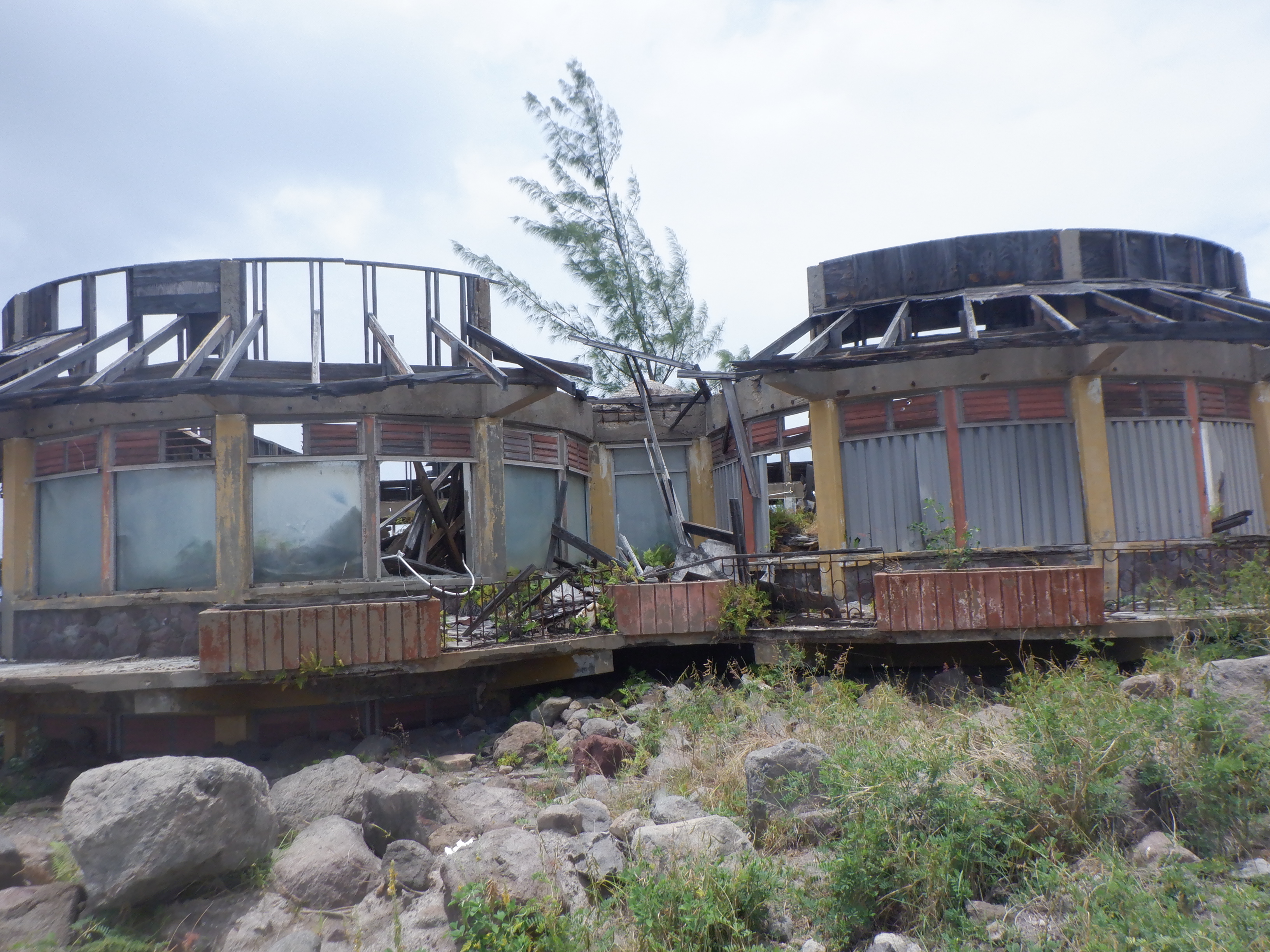


After the tour, we had a late lunch at the local restaurant. It seems as if we have visited two different countries or perhaps two different continents. One gray and ash-filled, the other a rainforest. Montserrat ahs built a new airstrip, an airport it is not. The few tourists that come here have difficulty finding a place to stay. We saw no hotels. As we drove back to Little Bay, we passed an area filled with large, luxurious houses. These were not locals, but obviously Americans and Canadians who had winter homes here so they could escape the cold back home.
There are few cruisers that sail here, the island has little to offer, BUT the experience of the buried city is worth the sail, even though the guide has set the price as high as he can get away with. We were two couples to split the cost, so it was reasonable and worth every penny.

Montserrat is a perfectly good substitute for the authenticity I was hoping to find on Saba. While I’m sorry we missed Saba, I’m happy we managed Montserrat.
When we weighed anchor, we sailed southward. Why southward? Aren’t we supposed to be sailing eastward toward Europe? Ah, but you will get the answer to that question in the next blog………….


 s/v capri