Many years ago, I read about St. John, USVI. That the island was more or less a National Park everywhere. That it was the most beautiful of all the Virgin Islands and that it was much less developed than St. Croix or St. Thomas.
Those descriptions have always made me want to visit. Ok, here we are on BVI and St. John is right next door, so to speak, less than a couple of nautical miles.
Of course, that meant we simply had to sail over there. It was a little further than a couple of nm, because we had to sail to the other end of the island to Cruz Bay, the only place we could clear in. Sailing amongst these small islands is a joy itself. They boast small bays with white beaches and as many of the smaller BVI islands are privately owned, only a few buildings. We were a bit apprehensive about visiting St. John. The BVI had disappointed us terribly (see blog). The bays there were filled with “Credit Card Captains” and huge charter catamarans, equipped with a hired skipper and a cook. We hoped St. John would be different.
A couple of hours after weighing anchor we reached Cruz Bay. The bays along the coast of St. John we could look into seemed mostly empty, a good sign we thought. Our years old Pilot Book noted that it was possible to anchor in Cruz Bay, but when we arrived, we quickly decided that there was no room for Capri. That meant Plan B. Sailing around the point to the next bay, anchoring up there and taking the dinghy back into Cruz Bay. We landed at the dinghy dock and looked around for the CBP (Customs) office. Nowhere to be found. After wandering down Vestergade (St. John has kept many of the old Danish street names), a local told us where we had to go. At the end of Vestergade, the ferry from the BVI docked and there was a CBP office. We had to walk around the building and get in line with the ferry passengers and then we could clear in. The smiling CBP officer immediately gave us a six-month entry and we exited onto the street, no legal.
Our first thought was to rent a car to drive around the island and get an impression of it as a whole. We couldn’t do that. The island isn’t big and we only wanted to rent a car for just one day. Unfortunately, all the rental companies only rent cars for at least 3 days preferably 5 or more days. No one would rent us a car for only a day (they must earn too much money). There is a reasonable explanation though. The tourist that come here stay in either B&B or small hotels all of which are scattered about the island. So are the beaches. If you aren’t on a boat, you need a car just to get to the beach or go shopping. So since everyone comes here for either 3, 5 or 7 days, that’s what the car rental agencies will rent you the car for.
On our way walking around the town, we passed The Danish Church. Even though it was American, it looked just like a Danish church on the inside.


Since we couldn’t rent a car and did have a boat, we could just sail around the island and visit those places we wanted to see. The waters around St. John are a national park and no anchoring is allowed. You must stay on one of the mooring balls. These are owned and operated by the National Park Service and they are well maintained and cheap. Our first stop after Customs was therefore the National Park Service office to buy a year card.
Most of the bays on this island are empty. There is no way to get to them except by boat and very few of them have any facilities, meaning toilets, beach chair rental, food trucks or anything else. The tourists all go to those few beaches that have these facilities, leaving the rest virtually empty. The crowds from BVI don’t come over here, because there are no bars, music etc. We like these kinds of bays. St. John is known as one of the best places to snorkel in the Caribbean. We did snorkel but after having experienced the south Pacific, we found the snorkeling tame and unworthy. There was some coral and some schools of fish, a sea porcupine but not much else.
One of the “must see” attractions on St. John is Anneberg, a National Historic Monument. The Anneberg Plantation stems from the time that the islands were Danish; Anneberg was a sugar-producing plantation and therefore had many slaves.
Denmark gained control and ownership of the island in 1718. The earliest notation on Anneberg is from 1721 when a Frenchman, Isaac Constantin, bought the property from the Danish government and started a plantation. The tax records note that at this time there were 24 slaves on the plantation. In 1758, Issac’s heirs sold the property to a Dutchman, Soloman Zeeger. The tax records show that at the time of the sale, there were 100 slaves on the property. Zeeger named the property Anneberg in honor of his wife whose first name was Anne.
In 1796, an Irishman, James Murphy bought the plantation and began growing sugar cane. When he died, the inheritance court noted there were 591 slaves on Anneberg. In 1818, the first Danish owner arrived when Hans Berg married Murphy’s widowed daughter.
In 1848, Peter von Scholten, the Danish Governor of the West Indies, proclaimed that all slaves on the islands were now free. This ended slavery in Denmark.
The sugar industry collapsed in 1860, in 1863 a Brit, Thomas Letsom Lloyd bought Anneberg. In 1867, St. John was hit by both a larger earthquake and a major hurricane. This definitively finished the sugar industry at Anneberg and Lloyd sold the plantation to George Francis in 1871. Francis, a former slave, had been the overseer for Lloyd during the years Lloyd owned Anneberg. Francis converted the plantation from sugar to livestock, raising cattle and sheep. In 1935, the Francis heirs sold Anneberg to Herman Creque.
In 1954, Laurence Rockefeller purchased the plantation from the Creque family and donated it to the National Park Service as historic monument, a designation it retains today.
As a Dane, Anneberg is a “must see” when visiting the island. We Danes are not proud of our slave-owning heritage. As slave owners, Danes were no better nor worse than all others were. But Anneberg tells a story of our long-ago history as a nation with colonies and so is important even though Anneberg only had one Danish owner.
We took the dinghy in and dragged it up on the beach. A path follows the beach for a few hundred yards before turning inland and going up the mountain. After a mile or so of walking, the first buildings of the plantation show up through the forest. These are the ruins of some slave huts. There is not much left, but clearly, the slaves lived under poor conditions. Further up the hillside we reach the plantations center. The main house is a ruin as is the rest of the plantation. The big stone windmill still stands, albeit without wings. Back in the sugar days, there was a grinding mechanism inside. The slaves would feed the newly harvested sugar cane into the press where the plants juice was pressed out. The juice fell down below and out through a stone aqueduct, down the hill to a house with copper kettles where the juice was boiled and turned into molasses.
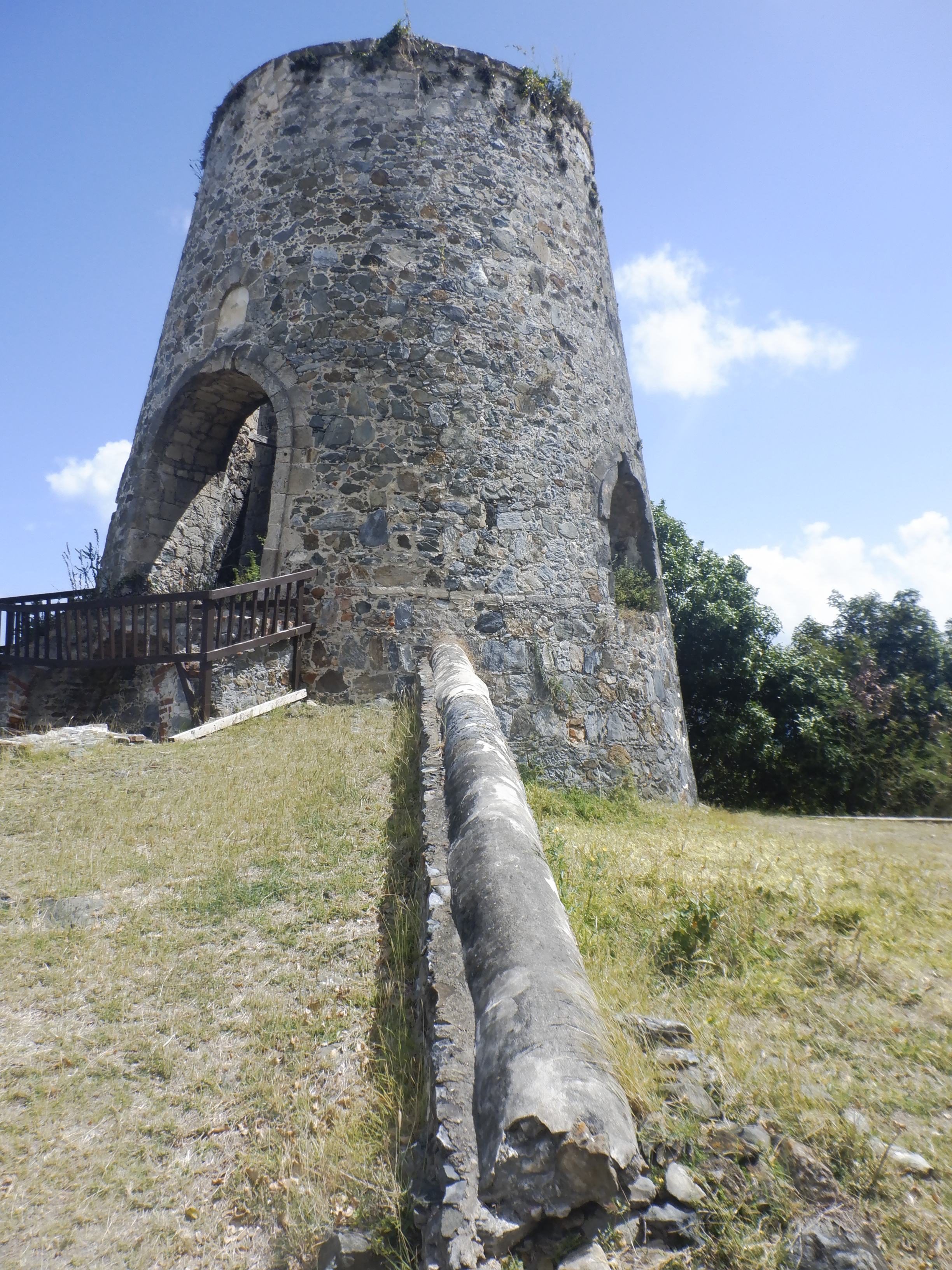
The molasses could then be further distilled into either raw sugar or rum. The work at the press was dangerous and many slaves lost either a hand or arm while feeding the press with the cane.

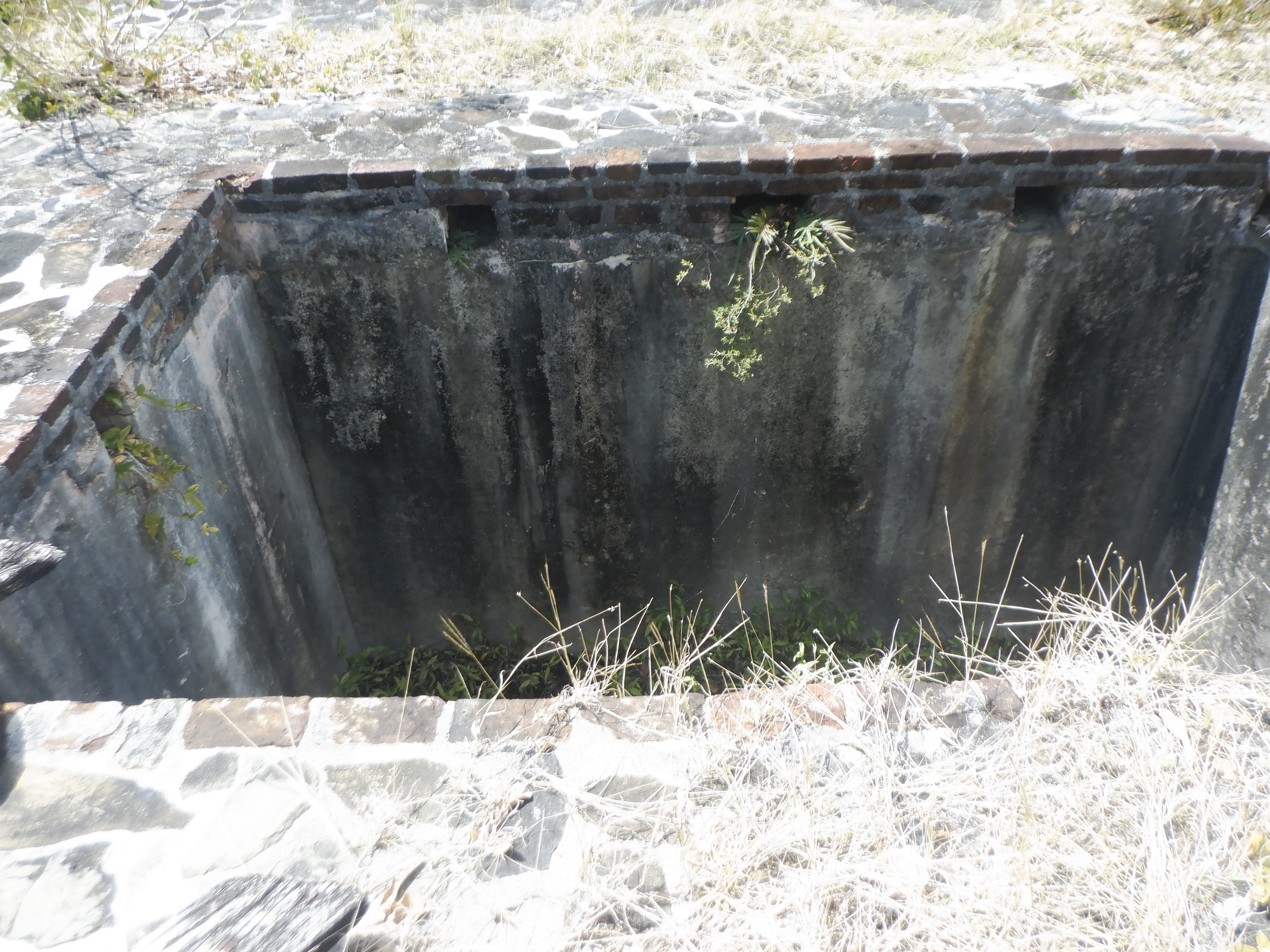
Here, alongside the mill, we found the “hole”. Slaves that needed to be punished were sentenced to days in the “hole”. In those days then hole had roof and it simply isn’t possible to imagine how hot it must have been when locked down there for several days. The alternative was whipping.
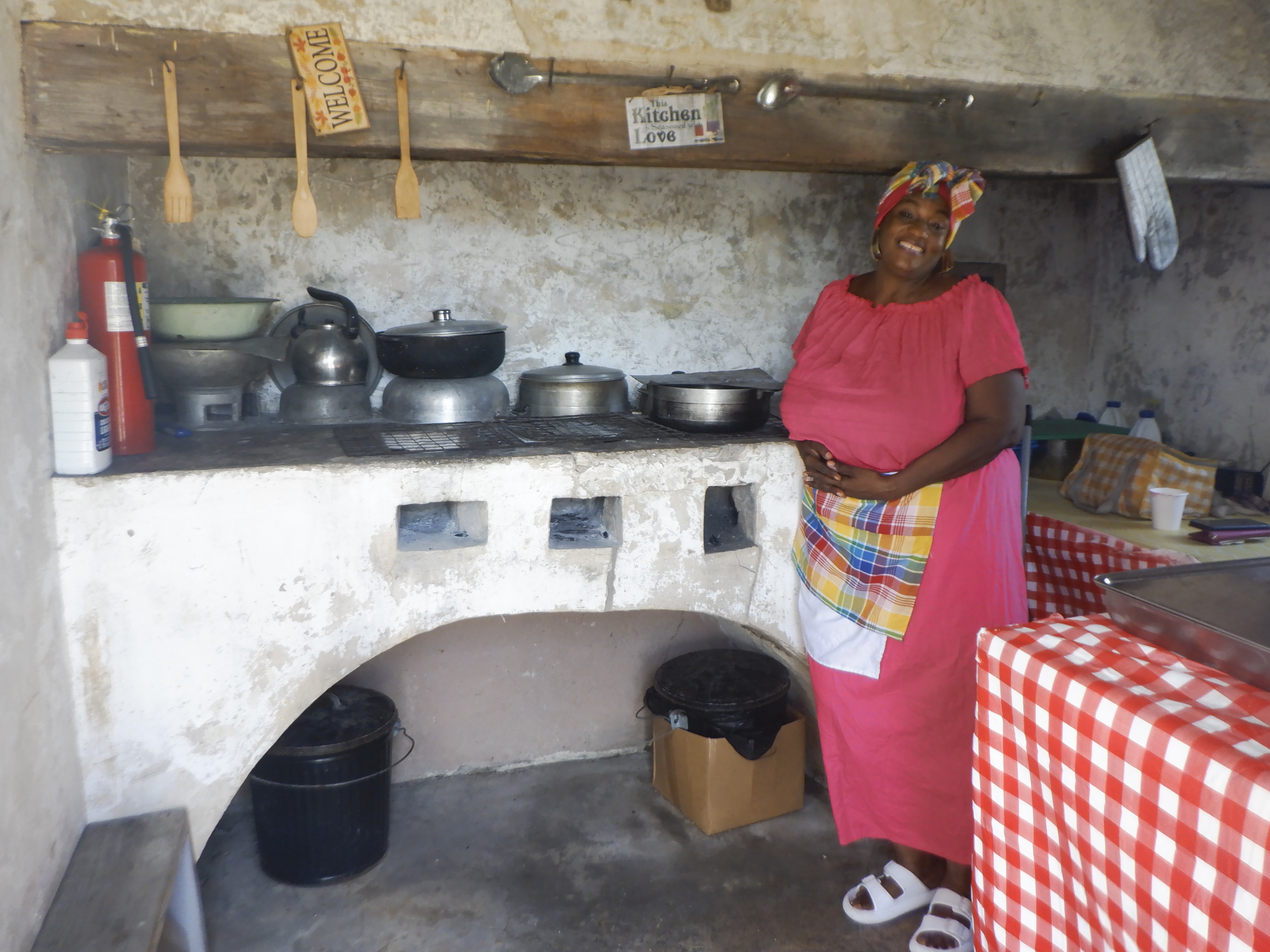
During the weekend, the National Park Service opens the plantation bakery and since we are visiting on a Saturday, it is open and Olivia is hosting. Olivia is wearing a traditional dress and bids us welcome with a wide smile. The bread is good. We tell her we are Danes and while happy to visit the plantation, we are not particularly proud of our slave-owning heritage. She laughs lightly and says, “Yes my ancestors came here as slaves, which was horrible. But their coming here as slaves means I can live here in Paradise, so who am I to complain?” A forgiving attitude if I ever heard one.
The north side of St. John is well known for snorkeling. We decide to give it one more chance and sail into Leinster Bay. From the water, we can see Anneberg far up the hillside. We drag the dinghy up onto the beach. There are almost no people here, certainly because there are no facilities here. There is only white sand beach and jade clear water. A beautiful beach (every sun hungry Dane’s fantasy) and crystal-clear warm water, but no ice cream, cold beer or toilets. Our pilot book says that there is a path from here over the mountain to Coral Bay on the western end of the island. The pilot books says the trek is only 4 kilometers, which we agree sounds doable without having to overly exert ourselves. We are planning to sail Capri around to Coral Bay for a couple of days anyway and this will give us the opportunity to see where we will end up.
Four kilometers is nothing, we decide to hike over, eat lunch, and if we are tired, we can simply take a taxi back.
The path starts out wonderfully, following the beach. We meet several wild deer along the way. They are not people shy and stare at us curiously.
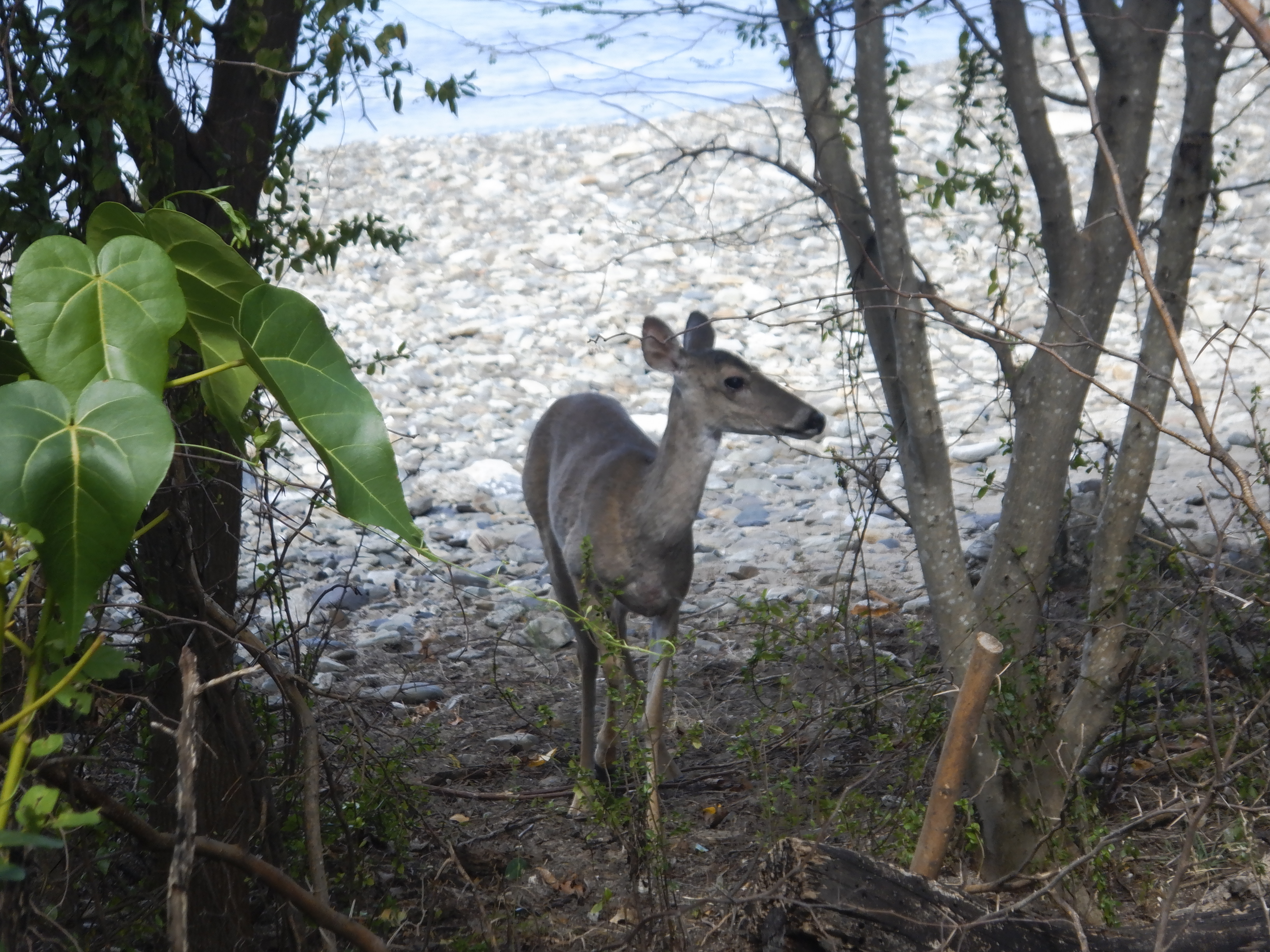
Discretion is the better part of valor, and when we get close enough, they wander slowly off into the brush. Now the path begins climbing up the mountain. It gets steeper and wilder. Now there are large rock formations we have to climb over. Up, up, up, we both now huffing and puffing (yes dear reader, we are no longer as young nor as fit as we were when we sailed away from Copenhagen 9 years ago. Our physical condition is terrible. We simply don’t get enough exercise). That Vinni and I both are five to six kilos overweight doesn’t help either.
Dear reader – the truth hurts.
But there is no way back. Our pride simply will not allow us to give up. I mean, a lousy four kilometers? We tell ourselves we can easily do this and begin fantasizing about ice-cold beer.
Success! The path begins a downward spiral. Hmmmm – maybe we shouldn’t start celebrating right away. Going down means having to come back up again. That, dear reader, is exactly what happened. The path went down the mountain and climbed back up again.
And again.
And again.
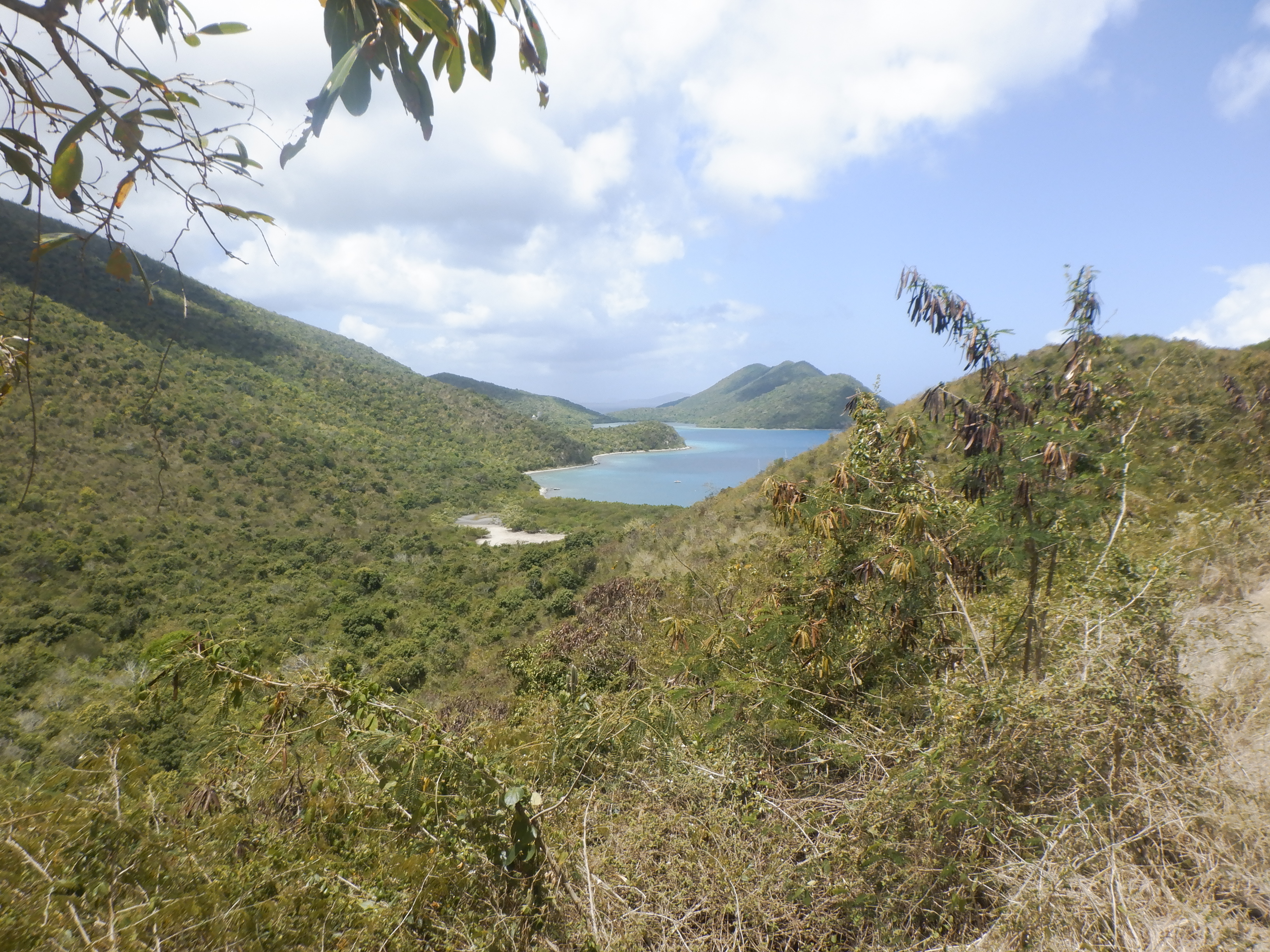
It climbed higher each time and I get exhausted just from the memory. We finally emerged from the forest onto a steep road. From here, it is a long couple of kilometers beside the water into town. The tourist brochure described the town as a charming older town well worth a visit. Ok, tourist brochures tend to exaggerate (read: lie). The town was small and the charm non-existent. We found a restaurant that served lunch (and cold beer). Lunch was good, though expensive. While eating we decided that Capri was not coming here. Partly because there was nothing here to see, but also because the bay was a poor anchorage. The wind and swells rolled directly into the bay and lying here would be an uncomfortable rolling affair.
Ok, that’s how life goes. Our feet and leg muscles were sore from the hike, so there was no way we were going to trek back across the mountain. We asked the waitress to call a taxi for us.
“Sorry, I can’t. We don’t have any taxis out here and besides, there are no cell phone antennas so we can’t use our mobile phones.”
I glanced at my mobile – yep no signal. So how do we get back to our dinghy we asked? Is there a bus? “Oh yes, there is, but it doesn’t go to where your dinghy is. When I want to go somewhere, I usually just hitchhike. Someone will always pick you up.”
We began walking back along the road that would eventually take us to our dinghy. I had my thumb up and ten minutes later a nice fellow in a pick-up truck stopped. He was a sailor himself, although he had not been active for many years. He asked about our trip and because he found it so interesting, he drove us all the way out the beach where our dinghy lay.
So the day ended well.
As we weighed anchor the next morning, we discovered that our refrigerator had stopped working. Sheeeit! The compressor was running but it wasn’t cooling. Almost certainly the cooling element. I started calling and there was a company on St. Martin that said they could repair it. St. Martin was a day-and-a-half sail and we weren’t going there, but we had little choice. The day-and-a-half sail was up against the wind. With no choice, we turned Capri into the wind and headed off to St. Martin.
The next day, we dropped the hook off St. Martin and the repairman came out to the boat. Despite my saying that I was fairly certain that the element had a leak, he insisted on filling the system with the gas coolant, saying that frequently, all the system needed was a refill. The leak was certainly small, he said and it would take several months before it needed refilling again. The next morning it had stopped cooling again. Now it was the entire system that was bad. Ok, the compressor ran fine, but ours is a though-hull system meaning that the coolant gas is pumped down into a spiral that sits in a thru-hull where it is cooled by the seawater. It is never the element, he said, when these systems start to leak it is always the cooling part down in the though-hull and then we have to replace the entire system. Unfortunately, to replace the through-hull, Capri needed to be hauled out of the water.
All this needed to be arranged (and it cost a ton of money). Finally, Capri was hoisted out, the repairman came and I have to say I’ve rarely seen anyone as incompetent. He couldn’t get the old through-hull out and I ended up doing it (He’s the repairman- I’m the customer). Then the new one needed mounting, again I ended up doing most of the work. I kept telling him I was sure it was the element. He kept insisting that he had been a repairman for over 30 years and he knew it wasn’t the element.
Job finished, Capri went back in the water and the next morning the refrigerator was not cooling again. This time the repairman was forced to admit that the problem was the element. So now, that was replaced and the refrigerator works. This little show ended up costing us $3500 and both Vinni and I were pissed, to put it mildly. Not only did we end up replacing the entire system when it was only the element, but I ended up having to do much of the work myself. Especially getting the old through-hull out. If I hadn’t done it, the repairman would have ended up destroying Capri’s hull.
Just one more example showing that it is better to do all the work yourself. I would have, except at one point we needed to braze a fitting on a tube. I don’t have a torch that can do that. So much for that story, the only saving grace is that the refrigerator was 10 years old, so perhaps replacing it wasn’t that bad.
We’ve turned our bow southward, making for St. Kitts and Nevis and Montserrat, the last eastern Caribbean islands that we haven’t visited. Vinni will tell that story.


 s/v capri