May 21, 2025, Capri left the Caribbean firmly lashed to the deck of the freighter – Stadiongracht. We can follow her on Marine Traffic. Capri has never sailed that fast, averaging 17.5 knots. While Capri sails one of the seven seas, we spend the time in our house on the Algarve in Portugal.
June 2 we flew to London and took the train to Southampton where we stayed in an IBIS Budget hotel. Fortunately, the hotel was right next to pier where Stadiongracht would lay to. We wonder what Capri will look like after her time on the Atlantic. We’ve heard the worst rumors from various sailor friends who have tried getting their boat shipped. We are expecting Capri to be covered in ash, dust and more dirt than we’ve ever seen, including oil splotches and whatnot. When one of our friends had his boat shipped there was a stowaway on board, who lived in their boat. Since he had no idea how to use the facilities, they came aboard to find feces and other nasty things throughout the boat. We’re hoping we don’t have one of those experiences.
Capri arrives late in the afternoon and the rain is coming down as if the Second Deluge is on its way. We’re happy we aren’t offloading in that. The forecast for the morning is cloudy, but dry. Let’s hope that holds.
The Loadmaster has told us to be at the ship at least a half hour before the scheduled unloading time, 8:30. Bright and early, 7:30 we are standing alongside the ship. Not a soul in sight. Capri is still in her cradle and looks ok. Finally, one of the crew comes on deck and after having made sure we have closed shoes on and have donned our hardhats, we can come on board. He fetches a ladder and Carsten can crawl up to unfasten Capri’s afterstay, so they can get the slings properly on her. After that, we just wait while the loadmaster finishes his breakfast and suddenly there is a whirlwind of activity.

Capri looks surprisingly clean. No oil splotches, no ash, no dust. While on passage, the crew has cleaned Capri’s bottom for only $250. Cheap and we would later be happy we paid it.
Now the procedure is the same as when we loaded, although in reverse.
The slings are fitted and the crane hoists Capri high over the railings, stops at deck level for Carsten and me to crawl over into the cockpit. The loadmaster signals the cranedriver and SPLASH! Capri is floating in the River Hamble. We check that there are no leaks, burp the axel packing, start the engine, refasten the afterstay and suddenly we are sailing around the corner to the Southampton Town Quay.
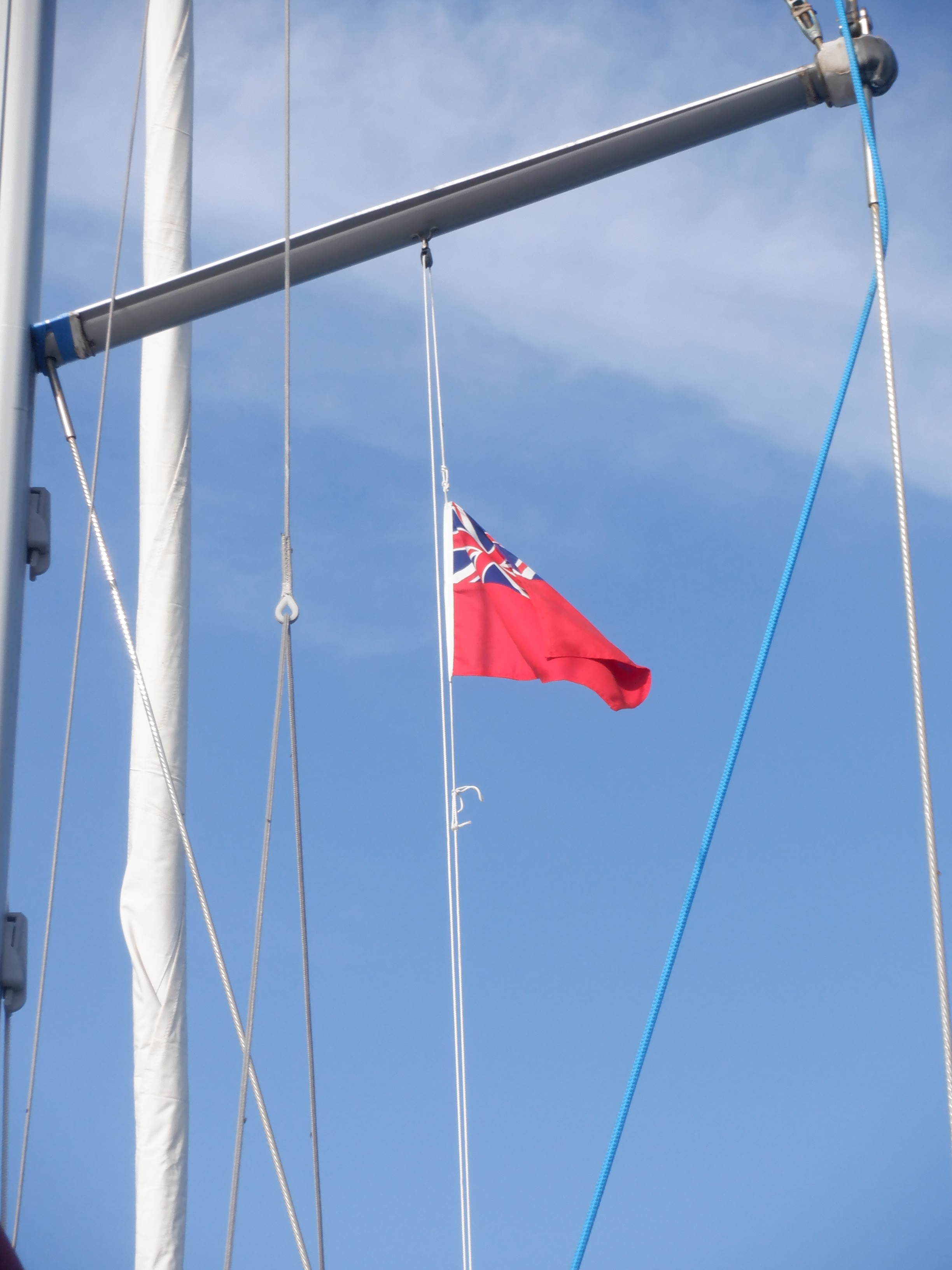
We stayed here for five days because we have to rerig the sails, and install our new radar. We also have to provision an almost completely empty boat. Not to mention clothes washing. After five days, we are ready to sail to Dover, 123nm away.
I’ve never sailed the English Channel, an area most cruisers discuss with nervousness and respect. Many say it is the ultimate sailing challenge because of the constant flow of large ship traffic in both directions, augmented by the heavy running tide that reverses every six hours. Added to that, the changeable and unpredictable weather that seems to love throwing heavy squalls at poor sailors. Most who sail the Channel have met a series of challenges. The Danish sailors I’ve spoken with or heard about have never sailed the channel double-handed (with just two). Carsten has been both up and down the Channel a number of years ago, but that was as a crewmember on a boat with a very experienced captain. Carsten has never skippered a boat up the Channel. Carsten sailed with Cameron on his 54-foot Moody, the Impromptu. Cameron has sailed the channel innumerable times, for him the Channel holds no secrets.
I am extremely nervous about this passage – if our good friend Cameron was on board, then I would not be nervous at all. Carsten admits that he hasn’t skippered a boat up the Channel, but he keeps telling me, “It’s not that big a deal; we’ve sailed through much worse. We just need to find a good weather window and everything will be fine.”
We ask Cameron and Kaj (Foreman for the Danish Ocean Cruiser’s Association) for some advice. Local sailors say you can make the run from Southampton to Dover in one day (123nm), especially now that it is summer with the setting late. I have trouble believing that Capri will be able to make the 130nm run during daylight – the tide turns every six hours so while we might go fast for the first six hours, when it turns we will stand almost still. Carsten and I spend a couple of days studying the tide and tidal current charts for the river Hamble, the Solent and the Channel. Whew, it is more than a little complex. The weather forecasts look hopeless, the forecast changes daily, sometimes more than once per day. Can we trust Windy (our weather forecasting software) here?
The day before we think we finally have a weather window, Carsten is surfing the internet and finds a website with a sailing plan for how to get to Dover in one day with a following tide the whole way. It turns out this can be done:
June 9 at midnight, we leave Town Quay Marina just after high tide. As I said above, the tide system here is very complex. Too complex for me to understand. The River Hamble has two high tides within an hour of each other. Ok, don’t understand, just accept it. We follow the tidal current charts and having an ebb tide the whole way down the river and out the Solent. After twenty-five nm we reach Selsey point at 03:30 in the morning, where it is slack tide and the current is just turning. This is the critical point; reaching here just as the tide turns means, you will have a following tide the entire run to Dover, one hundred nm away. It is difficult to believe, but true, we made the whole run with a following tide, the tide just beginning to turn against us five nm from Dover, sixteen hours later.
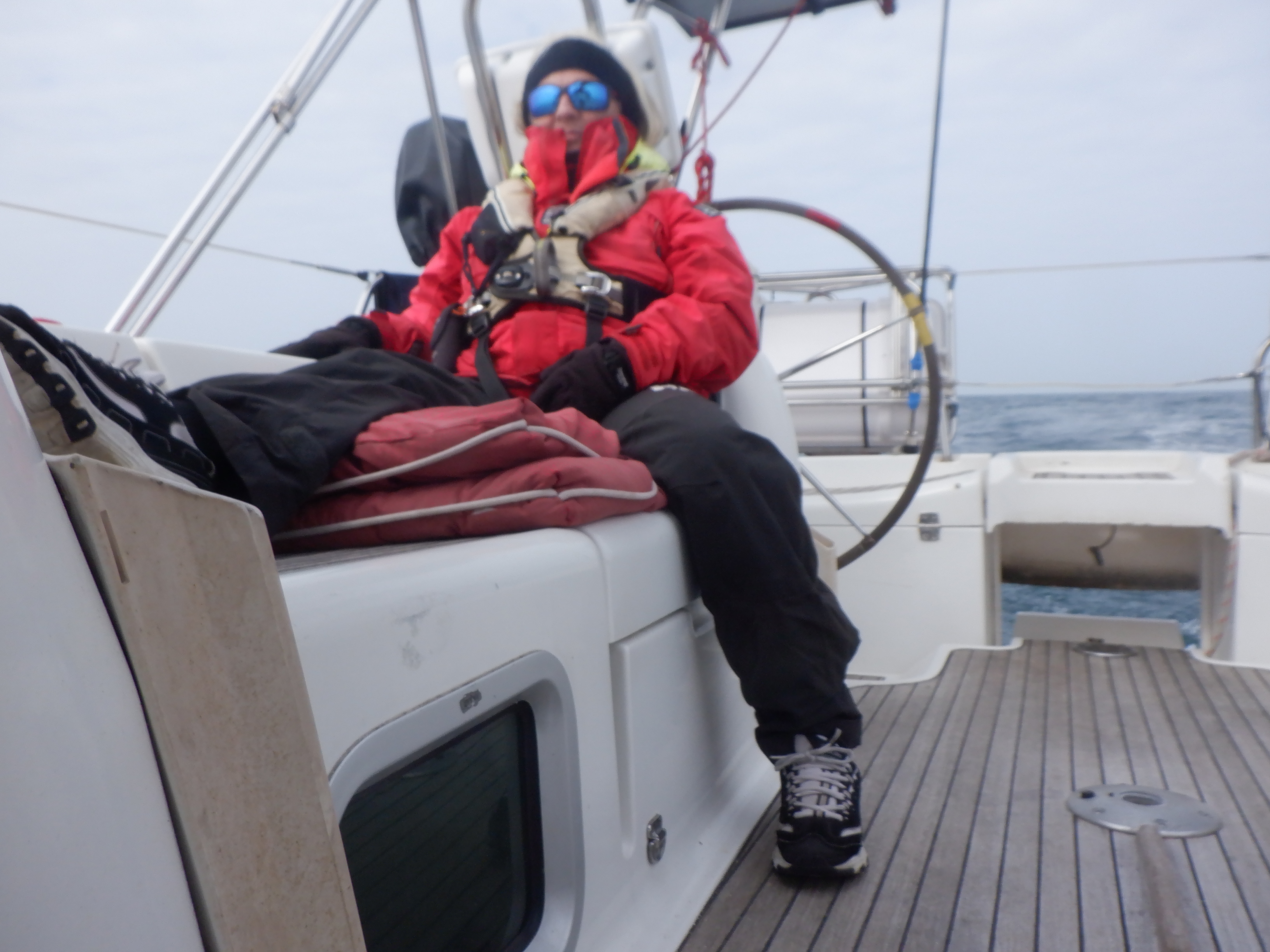
It was like sitting in a bathtub playing with your rubber duckys. No crabpots, no fishing nets, no fishing vessels. The big ships stayed out in the TSS (traffic separation system). The winds came from the southwest, blowing 8-10 knots. With both the sails and our engine running, we average over seven knots, which we need to make if we are going to keep the following tide the entire run. The chop is less than one meter so even the swells are gentle. A quiet and calm sail, much better than what one can hope for when traversing the English Channel.
I have to admit that I was both nervous and stressed when we sailed down the River Hamble. We only met two cruise ships coming the other way, so it wasn’t the ship traffic, but rather the multitude of buoys and lights blinking from all sides was confusing. Carsten had the helm and did a fine job navigating this “ocean of lights”.
We were also stressed when we reached Dover harbor. The tide had just turned and the winds were now much stronger, blowing twenty-six knots. The chop was now heavy with a three-second period and had risen to two- two and a half meters. The chop is hitting us amidships as we make for the harbor entrance. It is a wild ride, not helped by Carsten not being able to understand what the harbormaster in Dover is ordering us to do. He has a heavy accent. We finally come into the marina, thankful to be out of the “washing machine” we were sailing in outside. We’ll stay here for the next three days until we get a weather window that will allow us to sail the rest of the way up the English Channel.
Our plan is to sail from Dover to Helgoland (German island) a 360nm run. Wait there for a weather window then make the 160nm run north to Thyborøn and Denmark.
At noon on June 12, we took in our lines and left the marina. It is high tide and the tidal currents will give us a following current the next six hours or so. Leaving the harbor is at least as confusing as coming into the harbor.
We called the harbormaster and got permission to leave the marina, exiting into the main harbor. Once there we call again and ask permission to leave the main harbor out into the Channel. Dover harbor has two entrances. The south one is for pleasure boats (or so we thought; the north one for the ferries and big ships). The harbormaster still has a thick accent and Carsten is really having a difficult time understanding what he is saying. I’m at the helm and hear Carsten asking three times for the harbormaster to repeat what he is saying. He wants us to go to the north entrance and exit through that.
Carsten tells me that we are to sail to the north entrance and wait at the lighthouse for the harbormaster to give us permission to exit. I turn and start towards the north entrance.
Suddenly the VHF radio erupts, “Capri, Capri, you are in the way of two ferries coming in, get out of there!” Carsten runs to the VHF and finally we understand that the harbormaster wants us to sail over right next to the seawall and wait there. Then the harbor police come barreling down on us, telling us to get over to the seawall and wait there. When the two ferries have come in, the police boat escorts us out the north entrance and we are on our way. A rather ignoble exit.
Carsten is embarrassed, after all, we are not complete amateurs, but I’m relieved. We’re out and north of the ferry routes, which means we do not have to cross them. Now we just have to cross the English Channel and we head for the TSS so we can reach the French side of the Channel, just north of Calais. The TSS is crowded with ships, but we cross without incidence despite having the wind directly against us. Capri is fighting both a heavy foul wind and one and half meter high chop – true Vinni and Carsten weather.
Our strategy is to follow the TSS just inside the channel so we can avoid the fishing vessels and their nets. The wind veers to the southwest and lessens. We have to motorsail (using both the sails and the engine) since there is not enough wind for sails alone. We cross the Antwerp entrance channels without incidence.
For some reason, as the wind lessened, we were bombarded by flies and other insects. Literally bombarded, the sprayhood and surfaces in the salon were covered with lazy insects. We can’t take off our sunglasses because the bugs fly into our eyes. There are so many and they cover the floor and deck. When we walk, we step on them and there are fly bodies and blood everywhere.
The “normal” route here is to hug the coast, but we decide to stay further out and we skirt the giant windmill park outside of Rotterdam. There are three TSS routes coming and going here, Carsten crosses them all without problems while I sleep.
When I wake, I realize that in a couple of hours I will have to cross four TSS routes north of Rotterdam. Our chart plotter and radar show only light traffic, but there are many ships lying just outside Rotterdam waiting for a slot to go in. Apparently, this happens at 4 a.m. Suddenly, the chart plotter lights up with moving ships and I’m happy we are running only on the engine, which is easier if you have to make sudden maneuvers. Christ there are ships everywhere. I got through it without issue and I’m proud as a peacock when skipper wakes and I can tell him I crossed all four channels by myself.
The next two TSS channels are outside of Ijmuiden/Amsterdam and we had no issues crossing them. We are still motorsailing. The winds are light.
We are close to Hoek van Holland and the last two TSS channels. These TSS run along Holland over to German. Cameron, our sailing friend I spoke of earlier has recommended at that we stay just inside the TSS. We are allowed to do this as long as we don’t “impede” the big ship traffic. We stay right on the edge and have no problems with the big ships.
Carsten comes up from the salon after having studied the weather forecast and says that there is a perfect weather window to make the run to Thyborøn if we turn north now and don’t go to Helgoland. On the charts, we can see that there is actually a TSS that crosses the three big TSSs that run east west. If we use that then we will have crossed all the TSSs and be out in the North Sea. We turned Capri and happily avoided windmill parks, oil and gas rigs, not to mention fishing vessels and whatnot.
When dawn breaks (very early, we are now far north), we are past all the obstacles and running hard up through the North Sea. But this is Vinni and Carsten sailing and the winds are right on the nose, blowing twenty-five knots with heavy choppy seas running two – two and half meters. Capri fights for every nautical mile the next eight to ten hours before the wind veers south and lightens. Finally, the wind dies completely and now we are running on the engine alone. But, but, but – this IS Vinni and Carsten sailing, so the North Sea has decided to give us a worthy finish to our odyssey – fog. Heavy fog. We can see the front end of Capri, but nothing else and we are very happy we installed a new radar in Southampton. It has been running non-stop since we left Dover.
The fog is thick as pea soup and it is a strange feeling knowing that Denmark lies just behind the heavy white curtains that surround us. We can only “see” land on the radar. As we near Thyborøn, the fog starts lifting and we can begin to see the windmill towers in the windmill park just south of the entrance.
At 11:57, we can shout “Land Ho! Denmark”. We are a few nm from Thyborøn when suddenly an sms ticks in on my phone. “Welcome home” it says and it is from Kaj, the Foreman from the Danish Ocean Cruisers Association. He and his wife just happen to be in Thyborøn waiting for a weather window to cross the North Sea so they can sail to Scotland. They spotted us on their AIS.
Sailing into Thyborøn after nine years at sea is emotional. I have tears in my eyes and Carsten says, “Here’s the camera, go up to the bows and make a video. I can barely speak when I turn on the camera and I cry throughout the video.
I’m so happy to be home again and having arrived safely. It is only now that I feel we are safe from the raging seas.
At 12:45 we cross into Limfjorden, the stretch of water that crosses Denmark here. Just as we enter, two dolphins surface and swim around Capri. We can feel them welcoming Capri and us home. As we pass Thyborøn harbor, we can see Kaj and Charlotte standing on the breakwater waving small Danish flags. We are touched and the tears return.
Our challenges are not finished (so you thought all was well- didn’t you? Ha! This is Vinni and Carsten sailing). We had filled our diesel tank and also four 20-liter jerry cans when we left Dover, but we never thought we would be using the engine the entire way. Nobody, but nobody has an English Channel passage without a lot of wind. After 450nm of engine sailing, we were literally running on fumes. The fog has lifted and now we can feel a little bit of wind. We have decided to sail past Thyborøn and go into the harbor at Struer where we have friends. There isn’t enough wind to make hoisting the mainsail worth the effort, but we glide along only on the genua, making 3.5 knots. There are no waves, something we haven’t experienced in 9 years.
Our friends had no idea we were coming so when I called Lene hurried down to the marina, champagne bottle in hand. 18:45 and we tied Capri up, back in Denmark. Harry, Lene’s husband is traveling so he wasn’t there.
Our plan is for Capri to stay in Struer until August 1. Carsten and I are going to Portugal to start the major renovation of our house there. We will be back at the start of August and spend August sailing around Denmark but we promise to make landfall at:
Lynetten Lystbådhavn August 30 at exactly12:00
See you there


 s/v capri
Kære Vinni og Carsten. Velkommen hjem, safe and sound – er SÅ imponeret af jer og glæder mig SÅ meget til at se jer igen. Kærligst Lene ❤️
Well done!!! Epic cruising which you managed so well.
Get some rest in Portugal….
See you some where, some time!!!
Bob and Torill
Big Congratulations on successful completion of your epic voyage!
Jeremy, Svetlana and Misha
MSV Minstrel Boy