As we have written in previous blogs, we have decided to sail Capri back to Denmark making an eastward passage over the Atlantic. We have also decided that we will take the southern route from the Caribbean to the Azores instead of the northern route over Bermuda. The northern route starts from Florida, over Bermuda and then crosses, but it is a challenging route with potentials for high swells and storms. The route from Bermuda to the Azores also lies only 200nm from the lower edge of the iceberg line so it is a cold passage. Truly experienced skippers have recommended that we take the southern route, despite there being serious issues of ending up becalmed for many days due to lack of wind.
But that is for the future. First, we have to sail from Panama to the Caribbean islands over the Caribbean Sea. This passage is directly up against the trade winds (aren’t we just lucky?). So we can expect hard winds and current and swells all right on the nose. I can guarantee you, dear reader, that the following blog will be a description of misery compounded with more misery and even more misery. After all, it all is only 2000nm so how bad can it be?

In our last blog, Colombia, we noted we were lying in Santa Marta marina waiting for a good weather window for the crossing. After 2 ½ weeks, Windy (our forecast app) showed a perfect window. The plan was to sail 60 or so nm further eastward along the Colombian coast, then turn north, before we reached Punta Vela, where the weather is normally storm and the swells are 5-6 meters (on a good day). By sailing eastward, we stand a better chance of reaching the Dominican Republic and avoiding Haiti where chaos, hunger and crime are the order of the day. The forecast for the next week shows the wind starting from the east, moving to east/south/east and finally southeast. Perfect and we begin fantasizing about making landfall on Puerto Rice or even USVI.
Of course, this is Vinni and Carsten sailing – so how could it be any different from the forecast?
Day 1
May 22 at 10:00 am we return to Capri after clearing out at immigration. Colombian law says once you have cleared out you have to leave within 1 hour. The wind has picked up quite a bit more than promised, but we have no choice. We have to leave or else turn around and check in again (USD 300). We take in our lines and head out into a northeasterly wind blowing 20+ knots. The thunderheads are directly over our heads and the lightning starts as soon as we clear the breakwater. The complete opposite of the forecast and we give up even thinking about sailing eastward along the coast.
The sails are close hauled and we’ve got the engine running to enable us to sail even closer to the wind. Despite this, poor Capri is pounding her way through the swells and we are “putting down fence posts around King Neptune’s garden”. Our course is taking us either to western Haiti or Jamaica – not where we want to go. After four hours, we have an impromptu skipper meeting. Should we turn back and check into Colombia again? The lightning is smashing down everywhere, thunder roars every few minutes, the rain is pouring down so heavily that our VHF, AIS, and Radar can’t penetrate it. We are sailing blind.
The weather forecasts no chance of making this crossing for the next two weeks so it became a Hobson’s choice and we decided to continue. We need to get to Grenada, one of the most southerly islands in the Caribbean by early July when the hurricane season starts in earnest. We have reserved a spot on Grenada where Capri can go on the hard for the season.
The sailing doesn’t get any more pleasant as the day rolls on. Capri buries her bow completely in almost every wave, struggling to rise and get ready for the next one. The mood of the crew is low and certainly, I have difficulty trying to sleep when I am getting tossed around as much as I am. My appetite is gone, two small meatballs and a glass of milk are all I can’t manage to get down. Oh well, we both need to lose a couple of pounds.
Days distance – 131nm
Day 2
The thunder and lightning has thankfully stopped. We have some rain. The wind has lessened to 10-14 knots, the swells are still running 2-2.5 meters. Wind direction swings between north/northeast and northeast. Our course is between 0 degrees and 20 degrees. Depressing that we are steering directly towards Haiti. Trying to tack in this weather doesn’t work, we simply won’t get anywhere. Capri is toughing it out, still smashing her way through the swells. We try stopping the engine, but then we are being pushed so far to lee that it is hopeless.
I’m getting more and more frustrated over how wrong the forecast has been. I admit that after 40,000nm I should realize that you can’t always count on the weather forecast, but this is the first time we have seen such a wide discrepancy between a forecast and what we are getting.
Days distance – 142nm
Day 3
After a hard and wearying night watch, my mood is far below a low point. I’m pissed at the weather gods who have decided not to listen to me, this (despite what Carsten is wont to say) is not fun. Carsten sends me below to the bunk with reassurances that we will reach the Dominican Republic. After all, it is “only” 650nm further so this nightmare has to end at some point. Let me just clarify here – so far this has not been dangerous sailing, just damned unpleasant and of course, we have the concern about avoiding Haiti.
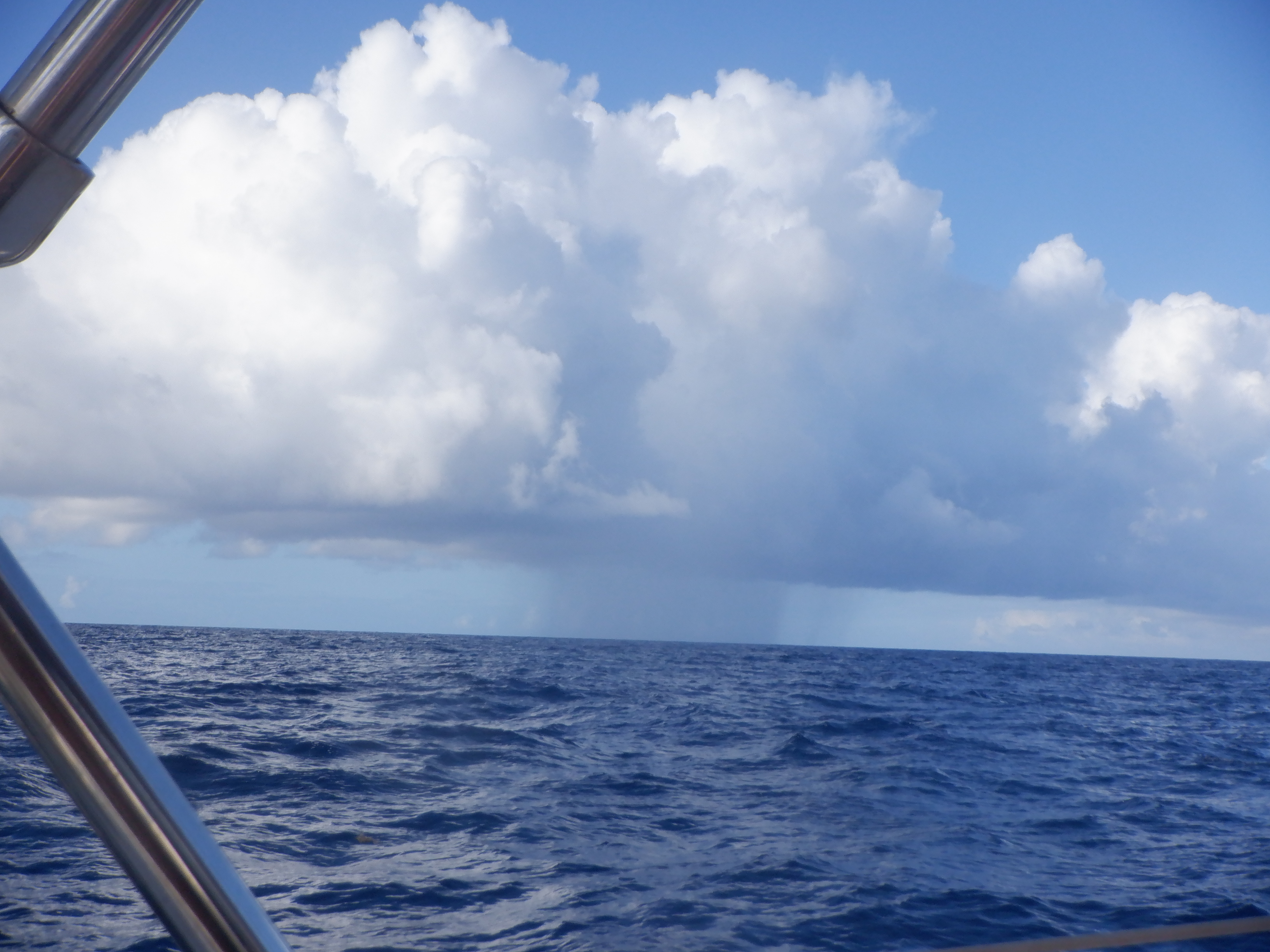
After a couple of hours sleep, Carsten can tell me that the wind has veered and is now from east/northeast, allowing us to turn and make a course of 40 degrees. This means we are now making eastwards progress, albeit only a little.
We’re still close-hauled and we’re still using the engine to help maintain our course.
Days distance – 148nm
Day 4
We can’t seem to make enough eastwards progress to avoid Haiti. We are unsure just how we will fight our way around the long peninsula that separates Haiti and the Dominican Republic. We are 60nm from the peninsula when we take in our sails and give the engine more gas, running now at 2000rpm. We are burning diesel like mad.
But we are able to make a course that will take us to the Dominican Republic. The weather gods decided they weren’t completely done with Vinni and Carsten yet, so just to remind us who really is in control, they send more lightning, thunder and rain.
Slowly we make our way up alongside the Dominican side of the peninsula, but here, there are strong “acceleration winds” blowing right on the nose. Poor Capri struggles to make headway. The engine is screaming. The weather forecast says we need to make our way at least 40nm deeper into the bay before we will find any relief from the winds, rain, lightning and thunder.
Are we having fun yet?
Damned right we’re having fun!
(No Carsten – we are NOT having fun!)
Late that morning, Carsten comes up to relieve me. I am nearly in tears. We haven’t passed out of the wind belt and the lightning, thunder and rain are still all around us. The swells are uncomfortable 2-3 meter chop and we still have 80 nm over the bay before we will arrive at the marina. Psychologically, I have just about reached the end of my rope and even my darling husband with his monumental patience has finally had enough of my moaning. He sends me to bed and says, “don’t get up until I come get you”
Yes, I really need to sleep.
Days distance – 142nm
Day 5
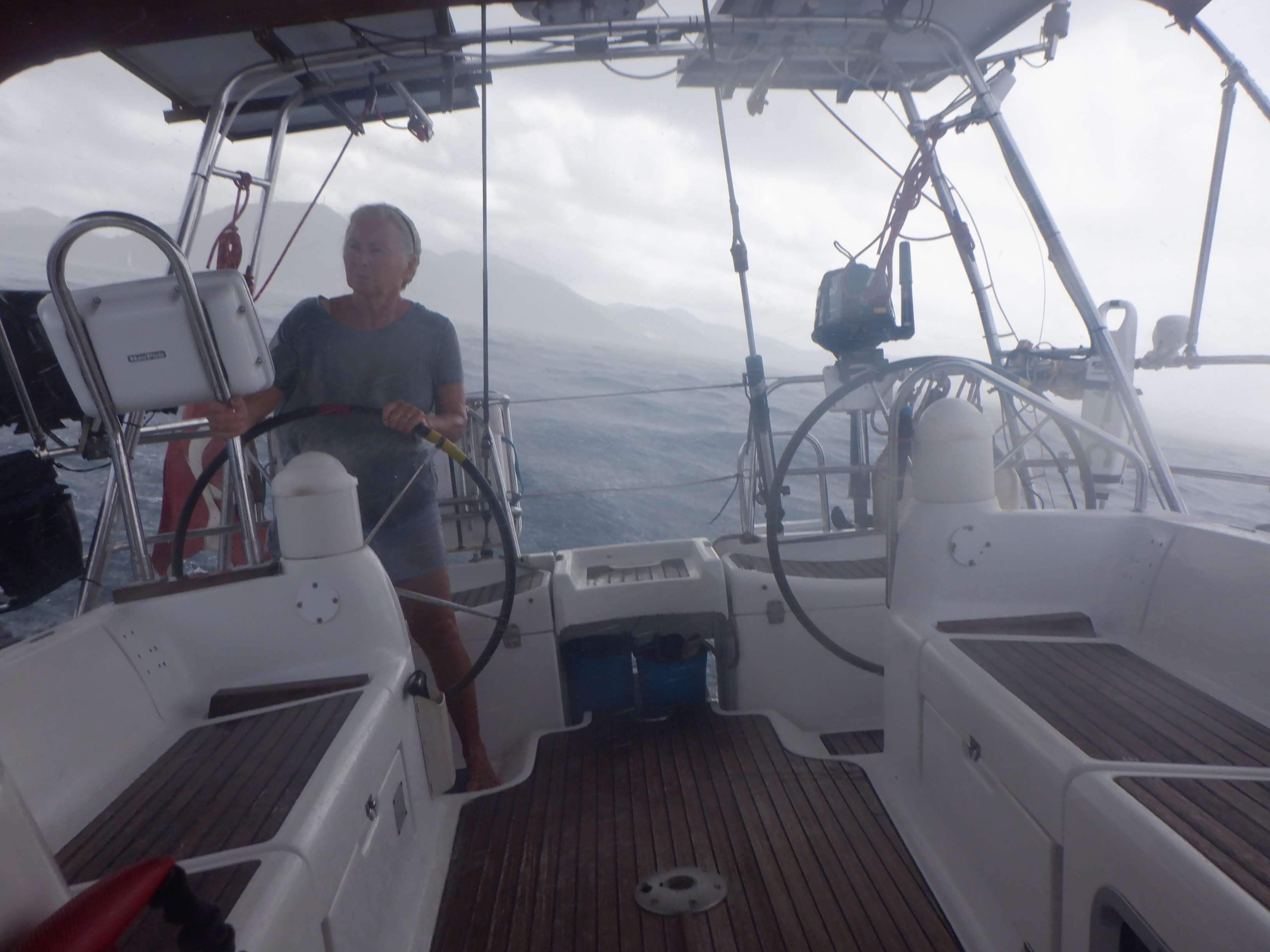
Carsten apparently has better lines of communication with the weather gods then me, because when I get up a few hours later, the wind has died down and the swells are now small and not chop. The forecast does say that the winds will pick up again this afternoon. Should we gamble on the swells being lower further in towards the coast? We decide to take the risk and to our amazement find that her, close in, the sailing is fine. Low rollers and no chop. We follow the coastline past Santa Domingo, the Capital, to Boca Chica, where Zarpar marina lies well protected in a lagoon.
After 4 ½ days miserable sailing, we finally make it into the lagoon. Our trials and tribulations aren’t don’t yet.
You didn’t really think that Vinni and Carsten could just sail in and tie up, did you?
Coming in we followed all the buoys that mark the channel as it snakes its way through the sand bars. Just as we near the last red buoy and are preparing to turn into the harbor, we run aground.
Hmmm. The chart says there is supposed to be 4 meters of water here. It is the middle of the night and fortunately, we have been coming so slowly that we can back off the sandbar. But it is not pleasant to find out that you can’t trust the depths shown on the charts.
Since we grounded, we decide simply to lay onto the very first dock. Ah but, that was not to be. As soon as we tied up several night watchmen came running and yelling to us in Spanish that this wasn’t allowed and we needed to move and they meant immediately. With a little help from our friend, Google translate, we’re told we need to proceed to the next dock; this one is a private club dock. Ok, but at two in the morning, the last thing you want to do is move the boat.
Days distance – 115nm
Total distance – 660nm
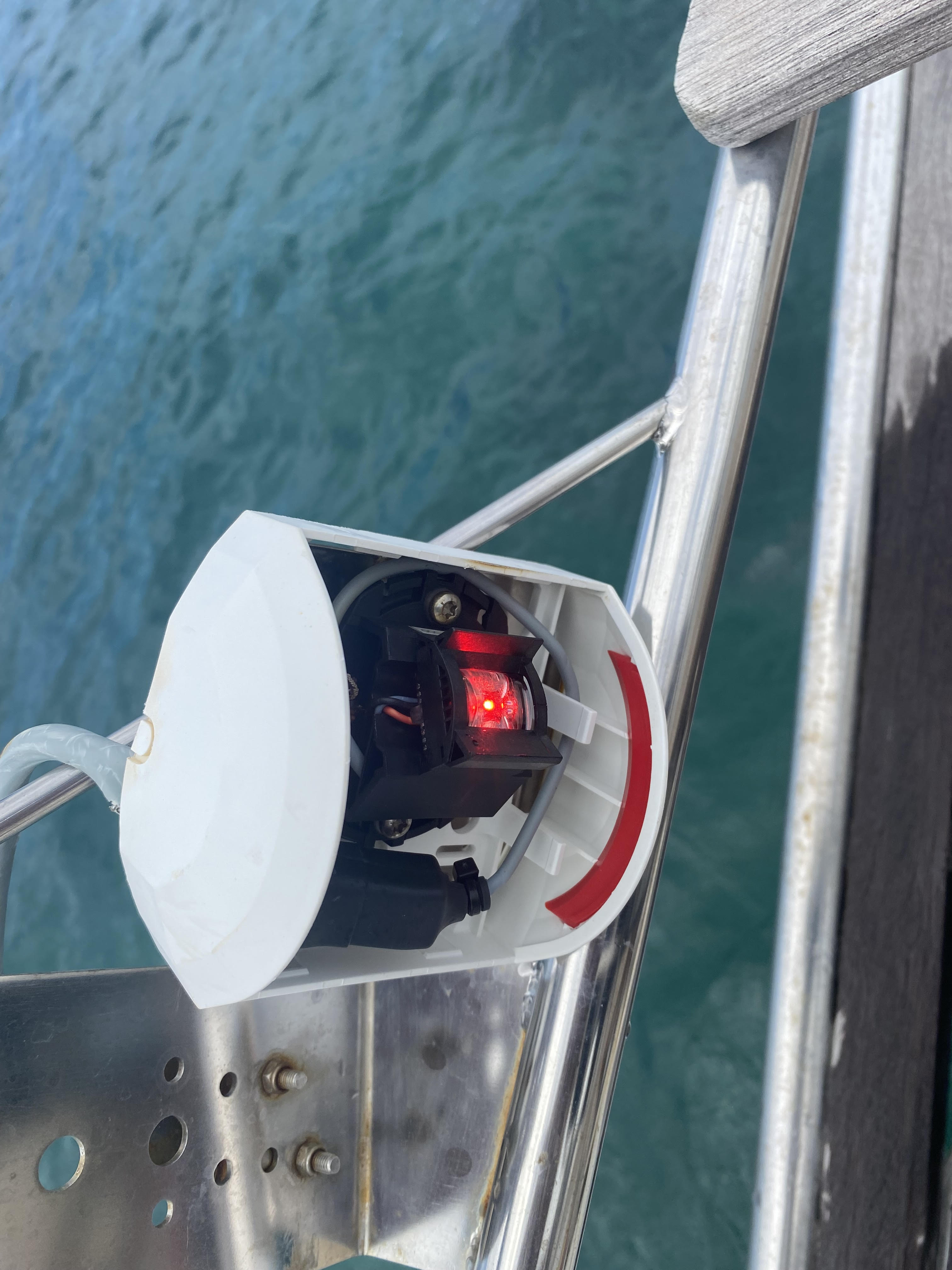
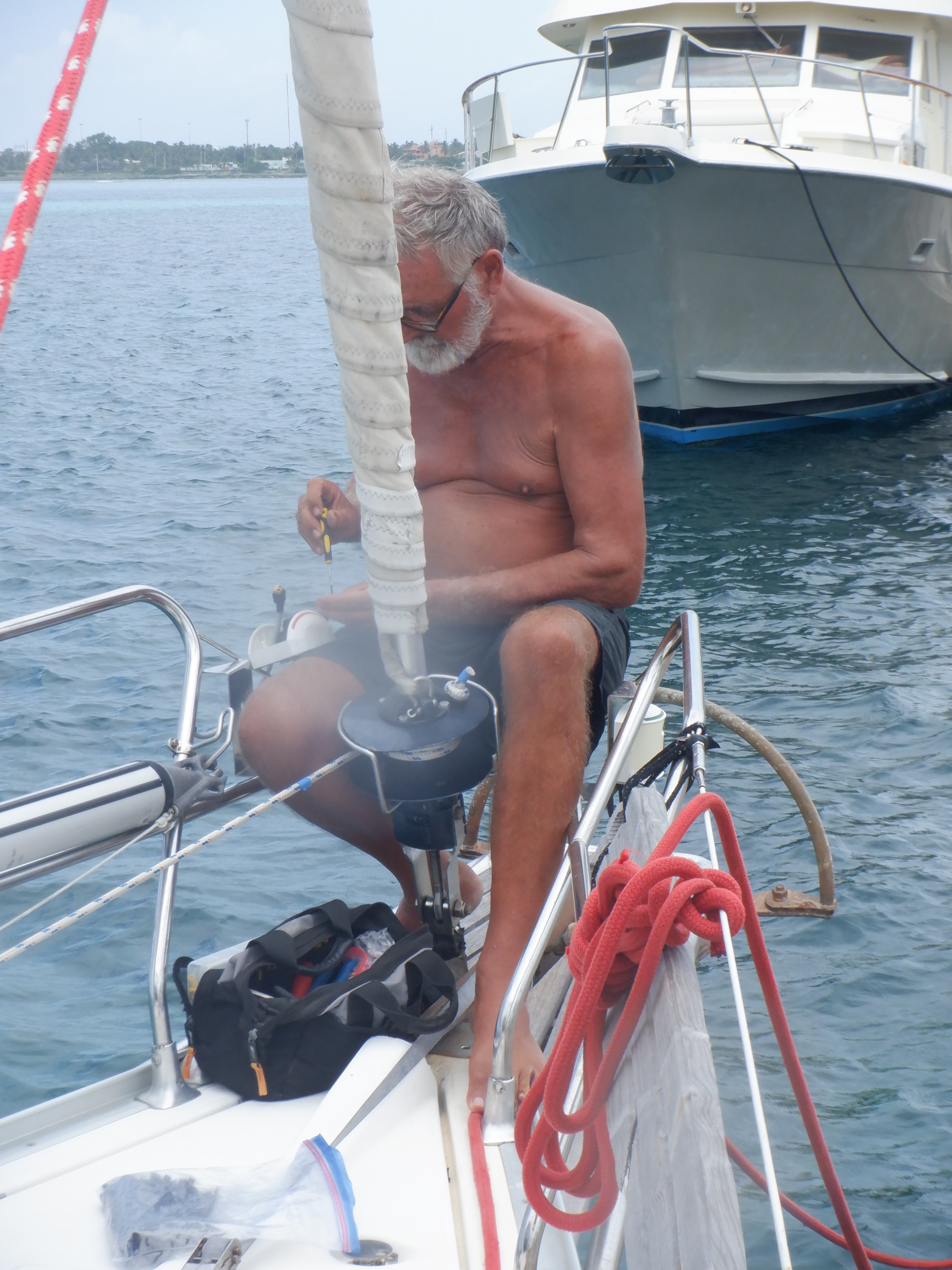

Onwards to San Juan, Puerto Rico
We slept hard after the rough passage and then a weather window opened up saying the wind would be from the southeast for the next two days. Off we go, deciding to go north around Puerto Rico in order to stay in the lee of the land and avoid the swells. The same weather forecast says that a storm is approaching and will hit the Dominican Republic early the next week, so we had better get going.
With the wind from the southeast, we expect to be able to use our sails for the 60 odd nm to the end of the island, go round the point and head northeast towards the northwesterly point of Puerto Rico, then onwards to San Juan.
The reality is, of course, different. Vinni and Carsten are sailing and that means no weather forecast can be trusted. For the next two days, the wind never comes close to coming out of the southeast. As usual, we have it right on the nose and poor Capri is again pounding her way through the swells. Finally, when we are about 40nm from the northwestern point of Puerto Rico, we find some lee from the wind and swells. The joy is short-lived however, 20nm from the point, the wind suddenly shift and is now from the northeast, we are once again running hard on the nose, and the swells are running 2 meters. We fight our way eastward through 2-3 meter chop for 60nm until we finally reached San Juan, entering the harbor at daylight.
Did you think this saga is done? Think again, my friend.
The harbormaster assigns us a slip and this is the first time since we left Denmark that we need to back inot a slip defined by two pilings. Normally this is a piece of cake for us, even though there is a wind on the beam.
We have never performed such a harbor show (yes, dear reader, they are probably still applauding). There are at least 5 immigration officers on the dock waiting to check us in and also two harbor workers.
Strong winds on the beam is something we are used to but here we also have a strong current that surprises us. The piling is also 3 meters high and much too high for Vinni to manage to get a line around. Carsten backs in at speed to counteract the current, but even though I tried throwing the line over the piling, I missed. Back out and try again. Same result. This time Carsten surrenders the helm to me and he will try getting the line over the piling. No way. Capri drifts sideways immediately as soon as I take a little speed off her. Carsten is nowhere near being able to get a line on the piling.
Last try. Carsten takes the helm and has the line. He thinks he can get the stern close up to the piling and then he can get the line tied on. If he can do that then I can haul the front end home and we will be in.
This time it is a total catastrophe. Carsten gets the stern in close, but he is forced to leave some speed on Capri. When he leaves the helm, to get the line on, our solar panels ram into the piling and now the one panel is hanging dangerously down the side of the targa bar.
Out again and this time we move over to a dock where we can lay to with our side. The harbor personnel say, “no, that is reserved for another boat.” After some negotiation, we are allowed to stay. The immigration people were very nice, got us checked in and then Carsten could get started repairing the solar array. Fortunately, it was only the mountings that were broken, a couple of hours later Carsten could tell me that everything was fine.
Our pride took a beating, but we can live with that.
After two days hard sailing and a crappy harbor maneuver, we needed a G&T and some sleep.
San Juan to Saint Martin
We chose to sail from Puerto Rico directly out to St. Martin, bypassing the American and British Virgin Islands, because St. Martin is further east and that means when we turn south, we will have both the wind and the swells on the beam. We need to sail 500nm south to Grenada where Capri will be on the hard while we visit Denmark.
Once again, the weather gods decide to tease us. They promise winds from the southeast, but send it from the east, so we are still sailing close-hauled with both sail and engine so we can hold a course for St. Martin. We are very tired of sailing transport sailing and truly tired of “Vinni and Carsten weather”.
The worries get more pronounced when the engine dies after a day. In San Juan, we changed the oil and filters. But it is apparent that the engine is suffering from fuel starvation. Carsten decides to change all the filters again while we continue on under sail. No help. Perhaps it is the fuel pump.
We have 20nm left before we reach St. Martin and the wind is dying. With the swells and current directly against us, it will be difficult to tack our way to the island. Carsten works with the small hand pump on the engine and finally gets it running again. Running is perhaps an optimistic word since it continues to die and runs up and down in rpms – but it is running. 1600 rpms is all it will do but we can limp into Marigot Bay after 1 ½ days and 200nm. The engine runs as we drop the hook and now we are safe at anchor.
As I’ve often belabored you dear reader, accidents always come in threes. The same is true here. When Carsten goes forward to drop the hook, the remote control for the anchor doesn’t work. At the same time, he sees that the past 1500nm of sailing through big swells has torn 2 of the wooden planks off our anchor platform.
The past couple of months have been hard on Capri.
Fortunately, our friends Ange and John from Australia are anchored here and the next couple of days John helps Carsten fix both the engine and the anchor winch.
The engine:
We’re sure the issue is fuel starvation. The only way to find the cause is to start from one end. We suspect that the fuel pump has crapped out. Since we had telephone contact with John yesterday, he went into town and purchased a small electric diesel pump so we can see if the problem is the pump. We bypassed the engine fuel pump with the electric pump, turned it on and said “Voila!”
Hmm – no diesel. Ok, next step. Despite having changed out both our fuel filters while at sea, we decide to take the Racor fuel filter apart. While we found a bit of dirt, there wasn’t enough there that it should give any problems whatsoever.
One little side note, dear reader. When we are tearing all this apart, it can’t be helped that some diesel is spilling out onto the floor etc. We also can’t keep just wiping it up immediately. It is dirty, smells and generally just not nice. Vinni says not a word, even though we can sense that she isn’t liking this at all.
Ok, so we bypassed the Racor filter, hooked the electric fuel pump up turn everything on and say “Voila!”
Hmmm. Still no diesel. Actually ,this was good news, since we now knew that the problem was either in the suction tube in the tank or the rubber hose coming from the tank to the Racor filter. We go straight to the tank. Getting at the inspection port of the suction in the tank is, quite naturally, not the easiest thing in the world, but after some minutes and multiple curse words (said silently), we got the suction tube out and could see that the suction strainer was completely clogged. We took off the suction strainer (not needed when we have dual fuel filters) remounted everything and fired up the engine. It ran and was spinning like a little kitten.
Chalk one up for a great team.
We suspect that we got some contaminated diesel in Chahaue, Mexico, where they sold us diesel form old barrels.
Before John and I partook of a well-deserved beer, we looked at the electrical part of the anchor winch. In other words – our work was not finished yet. Vinni, in case you haven’t suspected it, is a hard taskmaster.
Neither John nor I are electricians, but he has 18 years of cruising behind him and he has taught himself electricity. I’ve learned a lot over the past 8 years. After an hour of measuring and testing, we are sure that it is the remote that is has crapped out. It seems that the solenoid is also bad.
John and Ange sailed the next day while I went into the FEDEX office to pick up the spare remotes I ordered a week ago (I knew we had no spare and I also know that these tend to crap out after a year or so). It turns out I am lucky, the local chandlery has a solenoid so I can replace both. After some hours of work I say “Voila!”, but the winch still doesn’t work. Damned frustrating. After several hours of testing and more testing, a thought flashes through my mind. Could it be the new remote control that is kaput? I install the second spare and this time the wind spin like a top.
That takes care of the electrical side but I still haven’t fixed the salt water leakage. When we are sailing in heavy seas, the salt water leaks down alongside the winch axle and into our forward salon, dripping right down into our clean bedspreads and towels. This is not something that Vinni likes (neither do I) so fixing it is high on the priority list.
Fixing it requires pulling the entire anchor winch out. That in turn requires an axlepuller. While I have one, the one I have doesn’t fit on this so I simply can’t repair it. We will just have to wait until we get to Martinique where I can get some help.
From St. Martin to Martinique
The engine is running without any problems and the anchor winch is working, so on the 13. June we set sail for Martinique. For once, we have reasonable weather and can run on our sails for most of the distance before the wind dies and we have to use the engine. After 300nm and two days, we tie up at Le Marin marina on the southern coast of Martinique.
The Anchor
Here we can get help from the local boatyard that has the proper equipment. Carsten and one of the workers from the boatyard spend several hours removing the anchor winch (it was really hard in there). Lots of corrosion. The boatyard took the winch and cleaned it completely. Apparently, some water had also gotten into the gearbox and that needed cleaning. All the bearings and seals were replaced and now the anchor sounds like new.
We now have 4 weeks to sail the last 200nm to Grenada where Capri will be hauled. Storms and hurricanes can show up any time so we want to get to Grenada as fast as possible. Hurricanes on Grenada are rare. We keep a wary eye on the Atlantic to see if anything is developing out there, fortunately, there is nothing yet. Last year the first named storm showed up on June 1 – that is very early. These storm start developing near the African coast so we generally will have a few days warning.
Carsten and I are tired of these transportation passages. Since March, we have sailed over 4600nm and since we left Panama over 2000nm have been right up against the wind, current and swells. Both we, and Capri, deserve a break. Our plans are to be in Denmark from August to November and return to the Caribbean when the hurricane season is over. It is time to spend some time with our family and friends so our blog will pause until we come back in November.
Last update – Capri will haul July 23 and we will arrive in Denmark July 27.


 s/v capri
Nice Blog Carsten and Vinnie, thank you for shareing stories and valuable information. Pavel sv El Mundo